
TL;DR:
- Success depends on understanding and following community and platform promotion rules.
- Clear, well-formatted, and honest deal posts increase engagement and redemption rates.
- Consistent, compliant sharing builds trust and long-term visibility in target communities.
You post your referral code, wait, and nothing happens. No clicks, no redemptions, maybe a moderator quietly removes your post. This is one of the most frustrating experiences for referral marketers who put real effort into finding and sharing deals. The problem usually isn't the code itself. It's a mix of poor formatting, misunderstood community rules, and posting habits that trigger spam filters before anyone even sees the offer. This guide walks you through a practical, step-by-step approach to getting your discount codes noticed, clicked, and redeemed without getting flagged or banned.
Table of Contents
- Understand community rules and platform policies
- Prepare your deals for community success
- Share strategically to maximize visibility
- Monitor performance and adjust your approach
- Why true visibility favors compliance over volume
- Ready to boost your deals? Start with trusted platforms
- Frequently asked questions
Key Takeaways
| Point | Details |
|---|---|
| Know the rules | Community and platform guidelines are essential for long-term deal visibility. |
| Clarity drives results | Transparent code terms and user-friendly formatting boost engagement and trust. |
| Share smarter, not more | Strategic posting—timing, content, and channel—outperforms spamming every time. |
| Adapt and refine | Monitor code performance and feedback to continually improve your sharing approach. |
Understand community rules and platform policies
Before you share a single code, you need to understand the rules of the space you're entering. Every community has its own culture, and promotion policies are almost always stricter than first-time posters expect. Skipping this step is the single biggest reason referral code posts disappear without a trace.
Different communities treat promotional posts very differently. A subreddit focused on frugal living might allow one deal post per week per user. A Slack group for startup founders might prohibit promotional content entirely unless you're a verified member. Facebook groups often require moderator approval for any post containing a link. When you share codes fairly, you build a reputation that keeps your posts alive longer and generates more trust from other members.
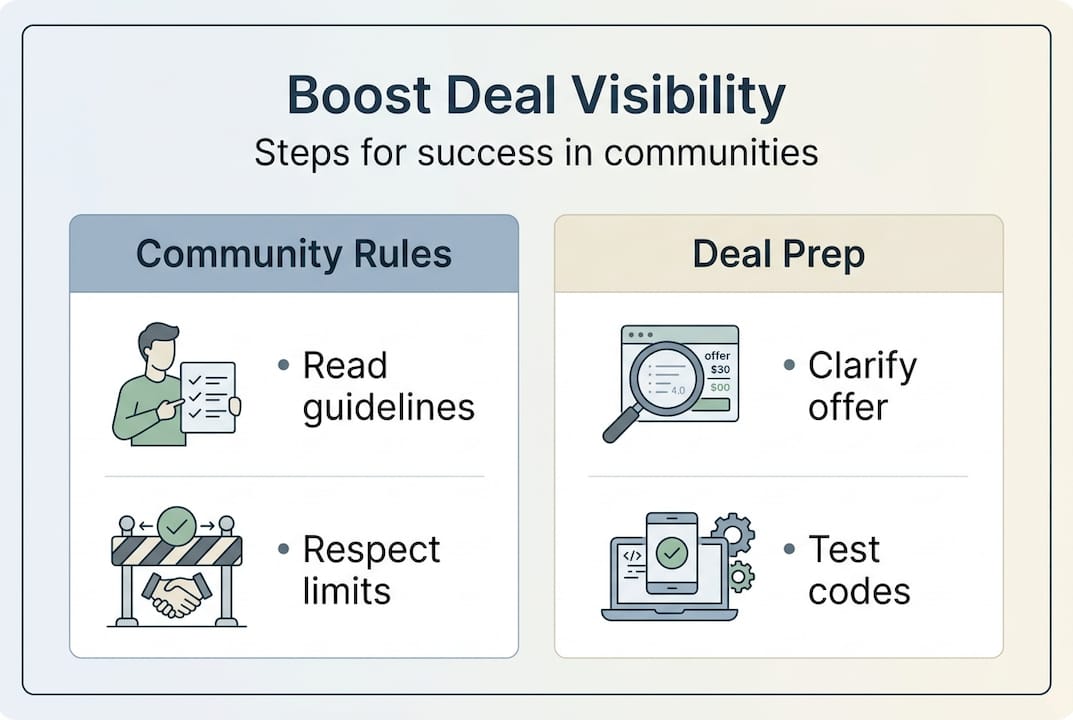
The key mindset shift here is to treat every community post like a pitch with constraints. As RevGenius community rules make clear, when seeding referral codes or promos in community spaces, you should follow community-specific promotion rules to avoid removal, treating sharing as pitching with constraints rather than blanket posting. Volume without compliance is just noise that gets muted.
Platform-level policies add another layer. Google Merchant Center promo policies require that promotions add genuine value, include clear redemption requirements and eligibility, and avoid being unnecessarily restrictive. These rules exist across virtually every major platform that handles discount codes, so they apply to more than just Google Shopping.
Here's a quick comparison of how typical community rules differ from broader platform promotion policies:
| Rule type | Community-level rules | Platform promo policies |
|---|---|---|
| Post frequency | Often 1 post per company per week | No specific frequency cap, but quality is enforced |
| Transparency | Must disclose affiliate or referral relationships | Must clearly state eligibility and redemption steps |
| Link restrictions | Many communities restrict external links | Links must lead to legitimate, functioning pages |
| Offer clarity | Community FAQ must be answered in the post | Offer terms must be unambiguous and complete |
| Consequences | Auto-deletion or ban for violations | Code disapproval or account suspension |
Common deal-sharing rules across most communities include:
- No posting more than once per week per company or offer
- No links to sites that require sign-up just to view the deal
- Must disclose any referral benefit you personally receive
- Cannot use misleading language like "unlimited" when the offer has caps
- Must include an expiration date or note if one is unknown
Breaking these rules doesn't just cost you one post. It can result in auto-deletion of all future submissions and a permanent ban from communities where you've built credibility over months.
Good community moderation tips always emphasize reading pinned posts, lurking before posting, and messaging moderators when you're unsure. That 10-minute investment can save weeks of rebuilding your reputation.
Prepare your deals for community success
Once you know the rules, the next step is crafting a deal post that's clean, clear, and genuinely useful to the audience. Many referral marketers underestimate how much presentation affects engagement. A code buried in a wall of text with no context will always underperform a concise, well-organized post with the same discount.
The most important principle is clarity. Your audience should be able to answer three questions in under five seconds: What is the deal? Who can use it? How do they redeem it? If any of those answers require effort to find, you'll lose people immediately. As Google Merchant Center promo policies specify, promotions must provide clear redemption requirements and eligibility and avoid conditions that are unclear or overly restrictive.
Use this checklist as a data table before every post to make sure your deal is ready:
| Deal element | What to include | Common mistake to avoid |
|---|---|---|
| Eligibility | New users only? First purchase? Location? | Leaving eligibility vague or unstated |
| Offer value | Dollar amount, percentage, free item | Saying "big discount" without specifics |
| Restrictions | Min purchase, excluded categories | Hiding restrictions in fine print |
| Expiration | Exact date or "no stated expiration" | Omitting this entirely |
| Redemption steps | Enter code at checkout, click link, sign up | Making redemption a multi-step mystery |
| Code validity | Verified and tested before posting | Sharing expired or region-locked codes |
Before you post, run your code through a code validation process to confirm it works. There is no faster way to destroy trust in a community than sharing a dead code. Members who waste time on a broken link rarely give a second chance.
Visual formatting also plays a larger role than most people realize. Posts that use spacing, bold text for key details, and short bullet points consistently outperform dense paragraphs in engagement rate. Emoji used sparingly, such as a checkmark or a dollar sign, can help key details stand out in feed views without looking like spam.
Essential formatting tips for a deal post that gets attention:
- Use bold for the code itself and the discount amount
- Separate eligibility, steps, and expiration into distinct lines
- Keep the entire post under 150 words unless the offer is complex
- Include a direct link to the offer landing page, not a redirect chain
- Test your formatting on mobile before posting, since most community browsing happens on phones
Pro Tip: Pair your deal with a one-sentence personal endorsement. Something like "I used this last week and saved $18" adds social proof that no amount of formatting can replicate. Just keep it honest.
Strong code rotation tips also matter here. If you manage multiple codes across communities, rotating them gives you fresh content while keeping each post compliant with frequency rules.
Share strategically to maximize visibility
With a well-crafted, compliant deal in hand, your next challenge is deciding when, where, and how often to share it. Strategic sharing is about matching the right deal to the right audience at the right time, not casting the widest net possible.
Here's a step-by-step sharing routine that balances visibility with compliance:
- Identify your best-fit communities by searching for groups where members actively discuss savings, deals, or the product category your code covers.
- Read and save the community rules before your first post. Screenshot the promotion policy if it's buried in a sidebar.
- Schedule your post for peak activity hours. Most communities see the highest engagement in the morning or early evening on weekdays. Check the community's post history to identify patterns.
- Format your post according to community norms. Some groups prefer plain text; others respond better to structured lists. Adapt your style to fit.
- Engage within the first 30 minutes after posting. Reply to comments, answer questions, and thank people who redeem. Activity signals keep posts visible in feeds.
- Update your post when codes expire or change. An outdated code left uncorrected damages your credibility far more than not posting at all.
- Wait the required interval before re-posting. If a community allows one post per week, wait the full week even if your code changes.
Across multi-industry code examples, the pattern is consistent: tailored sharing always outperforms volume-based broadcasting. A single well-timed post in a highly relevant community will generate more redemptions than five generic posts scattered across unrelated groups.

The risk of spreading too broadly is real. As RevGenius community rules highlight, multi-channel visibility can backfire if community promo rules are violated through spam or frequency issues, or if redemption conditions are unclear. Visibility is constrained by both user experience and policy compliance, not just reach.
Pro Tip: When you find and share referral codes across multiple platforms, use slightly different phrasing in each post. This keeps content fresh for communities that overlap in membership and reduces the chance of your content being flagged as duplicated spam.
The community referral workflow that works long-term is one built on consistency, not bursts. Show up regularly, engage genuinely, and share only when you have something worth sharing.
Monitor performance and adjust your approach
Posting is only half the work. The other half is watching what happens afterward and using that information to improve. Most referral marketers skip this step entirely, which means they keep repeating the same low-performing patterns without realizing it.
Here are the most reliable ways to monitor your deal's performance across communities:
- Track comment activity. Questions and confusion in the comments are a signal that your deal terms need clarification. Positive comments and "thanks, worked!" replies are a signal to replicate the format.
- Watch click-through and redemption rates. If you use a unique link per community, you can directly attribute redemptions to specific posts. This is the clearest performance signal available.
- Monitor post lifespan. If your posts consistently disappear within 24 hours, you're likely triggering a spam or frequency rule you haven't identified yet.
- Collect informal feedback. Asking "was this easy to redeem?" in your post or in a follow-up comment gives you qualitative data that click rates can't provide.
- Track community standing. Are moderators engaging with your posts positively? Are other members tagging you in deal-related threads? These are signs that your sharing strategy is building real credibility.
Pro Tip: Create a simple tracking spreadsheet with columns for community name, post date, code used, number of comments, and estimated redemptions. After four to six weeks, patterns will emerge that tell you exactly which communities and formats are worth your time.
When something isn't working, diagnose before you delete. AI-verified referral deals can help you confirm whether a code is still active, so you're not guessing whether the problem is the post or the offer itself. Similarly, reviewing exclusive March offers can reveal which deal formats performed well in recent cycles, giving you a benchmark.
Common mistakes that show up most often in the monitoring phase include posting too frequently and triggering auto-moderation, using deal terms that generate confusion rather than excitement, and failing to update expired codes which sit in communities as dead links. Each of these is fixable once you identify it. The key is building a feedback loop that catches problems within days, not weeks.
As RevGenius community rules reinforce, community-specific promotion rules such as anti-spam limits exist for a reason. Ignoring feedback that points to rule violations is how referral marketers lose their best channels permanently.
Why true visibility favors compliance over volume
Here's the take that most deal-sharing guides miss entirely: visibility is not a numbers game, and treating it like one is the fastest path to irrelevance. We've seen referral marketers post in 50 communities a week and generate fewer redemptions than someone who posts in three communities with care and consistency.
The reason is trust. Community members have been burned by dead codes, misleading offers, and spammy accounts. When you follow the rules, keep your terms clear, and show up as a reliable contributor rather than a broadcast account, people actually read your posts. They bookmark them, share them with friends, and come back to your profile when they need a deal.
Cutting corners might give you a short spike in impressions. But the moment a moderator removes your post or a member calls out your expired code, you've damaged something that takes months to rebuild. Platforms like best referral code sources show consistently that the most visible deal sharers are also the most compliant ones. That's not a coincidence.
Long-term deal visibility is built on a foundation of transparency, rule-following, and genuine value. Everything else is just tactics built on top of that foundation.
Ready to boost your deals? Start with trusted platforms
If you've been sharing codes manually across communities with mixed results, there's a better starting point.
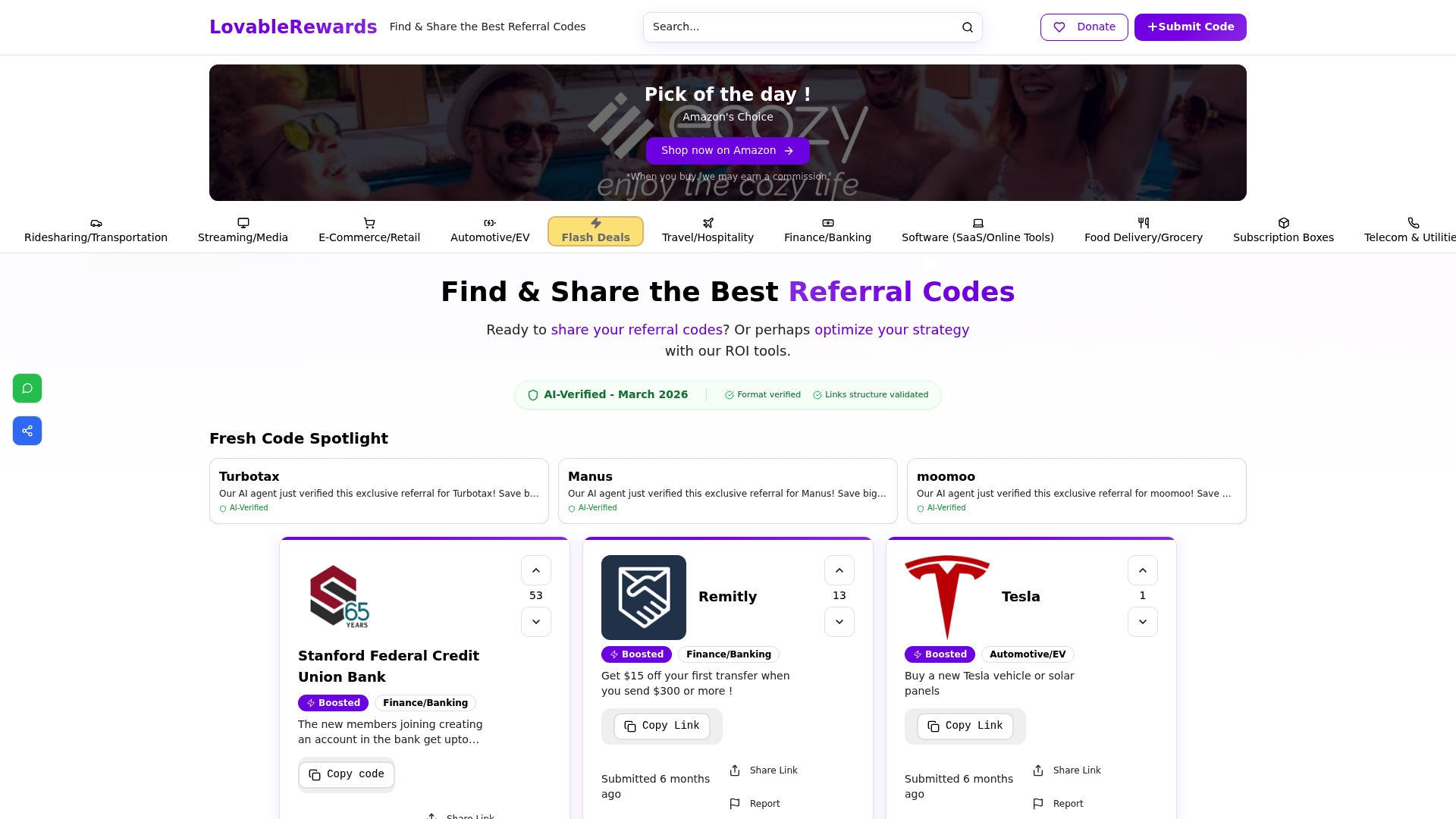
LovableRewards is built specifically for referral marketers and deal sharers who want verified, compliant, and visible code distribution without the guesswork. The platform uses AI-based verification to confirm that every code is active and every link is legitimate before it reaches the community feed. A fair rotation system ensures your deals get equal exposure without requiring you to spam multiple channels. You also get access to guides, moderation support, and real-time tracking so you can refine your approach based on actual data rather than gut feel. It's the compliant, transparent environment that serious deal sharers need.
Frequently asked questions
What happens if I break a community's promo sharing rules?
Your post may be auto-deleted or removed immediately, and repeated violations can result in a permanent ban, drastically reducing your deal's visibility and your ability to share in that space again.
How explicit do my deal terms need to be?
Deal terms must be fully clear, including who is eligible, how to redeem, and any restrictions, because promotions must provide unambiguous redemption requirements and eligibility to comply with platform policies and avoid being flagged.
How often can I share the same referral code in a community?
Most communities enforce a strict limit, and platforms like RevGenius specify no more than one post about a company per week to keep the space free from spam and genuinely useful for members.
What are warning signs that my deal post is too restrictive?
If members frequently comment with confusion, report that they can't redeem, or your post is flagged by moderators, it likely means your offer is unclear or overly restrictive and needs simpler, more direct terms.