
Referral codes promise real money, but most people leave those rewards sitting unclaimed. Expired links, fake codes, and confusing redemption steps kill the deal before it even starts. The good news is that once you understand how community referral workflows actually operate, you can move through the process with confidence, grab verified discounts, and stack rewards across multiple platforms. This guide walks you through every stage, from finding a legitimate code to confirming your payout, so you stop guessing and start saving.
Table of Contents
- Understanding community referral code workflow
- Prepping for referral rewards: What you need
- Step-by-step: How to use referral codes for maximum discounts
- Verifying rewards and avoiding fraud: Troubleshooting and best practices
- Comparing outcomes: How referral codes beat other savings methods
- Take your referral savings to the next level
- Frequently asked questions
Key Takeaways
| Point | Details |
|---|---|
| Referral workflow basics | Referral codes unlock mutual rewards through simple steps: generate, share, redeem, and qualify. |
| Maximize savings | Target high-payout sectors and verify codes on official platforms to ensure maximum benefits. |
| Avoid fraud pitfalls | Use best practices to prevent abuse and guarantee rewards by checking verification and appeals processes. |
| Referral ROI advantage | Referral programs offer higher retention, greater savings, and better conversion rates than other methods. |
| Tools for tracking | Use calculators and ledgers to track your referral rewards and optimize your community strategy. |
Understanding community referral code workflow
A referral code workflow is not just a link you paste into a checkout box. It is a structured system with moving parts on both ends. According to the customer referral program model, the process typically involves an existing user generating a unique code, a new user redeeming it, mutual rewards being issued, and backend fraud checks running in parallel. Every step is tracked.
The biggest design choice any program makes is whether to offer double-sided or single-sided rewards. Double-sided means both the referrer and the new user get something. Double-sided rewards boost sharing by 41%, but they also attract abuse. Single-sided programs are simpler and actually convert 2.6 times better on average because there is less friction for the new user.
Understanding dynamic codes in finance referral programs is especially useful if you are targeting bank or fintech offers, where codes rotate frequently and expire fast.
Here is a quick comparison of the two reward structures:
| Feature | Double-sided rewards | Single-sided rewards |
|---|---|---|
| Who benefits | Referrer and new user | Referrer only |
| Sharing rate | 41% higher | Baseline |
| Conversion rate | Moderate | 2.6x higher |
| Fraud risk | Higher | Lower |
| Best for | Community growth | Simple campaigns |
Key code formats you will encounter include:
- Alphanumeric codes (e.g., SAVE20XJ): most common, easy to share
- Unique URLs: tied to a specific account, harder to fake
- QR codes: used in mobile apps and in-store promotions
- Dynamic tokens: rotate on a schedule, common in fintech
If you want to learn more about setting up referrals from the program side, that context helps you understand why certain codes expire or require specific actions.
Prepping for referral rewards: What you need
Knowing the workflow is step one. Having the right tools and sources lined up is step two. The safest place to find active codes is directly inside official apps, bank portals, or fintech dashboards. Bank and fintech referrals from major platforms are updated regularly and carry verified terms, which means fewer surprises.

For broader discovery, high-LTV sectors like banks and fintech offer some of the best payouts, with programs like Chime and SoFi paying $50 to $100 per referral. E-commerce and service apps tend to offer smaller but stackable rewards.
Here is a quick reference table for common platforms and what you need:
| Platform type | Example | Eligibility | Min. action |
|---|---|---|---|
| Bank/fintech | Chime, SoFi | New account | Direct deposit |
| E-commerce | Amazon, Rakuten | New user | First purchase |
| Service apps | Uber, DoorDash | New signup | First order |
| Subscription | Netflix, Hulu | New subscriber | First payment |
To avoid wasted effort, check these before redeeming any code:
- Confirm the code is listed on an official source or a verified aggregator
- Read the expiration date and eligibility rules carefully
- Check whether the reward is cash, credit, or a discount
- Verify whether the reward requires a minimum spend or deposit
For curated, community-verified offers, browsing real offers for March 2026 gives you a filtered starting point without the noise.
Pro Tip: Always check the official app or website first, then layer on a cashback platform like BeFrugal to double your return on the same transaction.
Step-by-step: How to use referral codes for maximum discounts
Once you have your code and your tools ready, the process is straightforward if you follow it in order. Skipping steps is the most common reason rewards never show up.
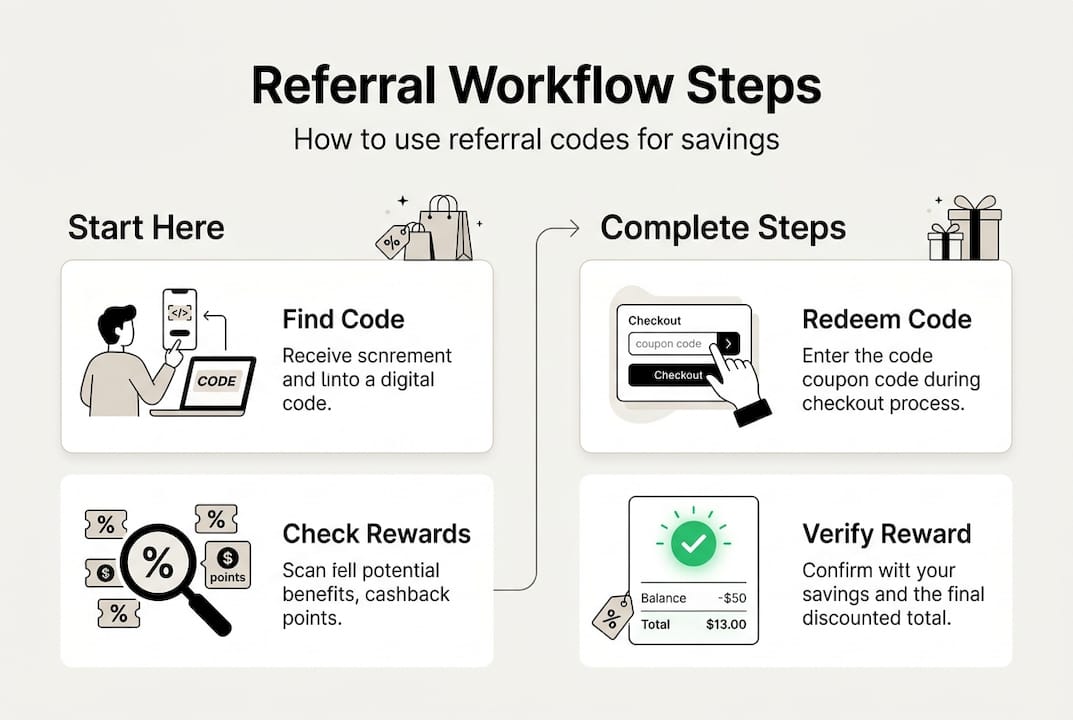
- Find or generate your code. Log into the referring platform or check a verified aggregator. Copy the exact code or unique URL.
- Share or redeem the code. Paste it at checkout, enter it during signup, or use the referral link to create a new account.
- Complete the qualifying action. This is the step most people underestimate. Rewards activate post-qualifying action such as a first purchase, a deposit above a set threshold, or full account verification using dynamic discount codes.
- Track and unlock your reward. Log into your account dashboard and check the rewards or credits section. Some programs show a pending status first.
For high-value programs, the numbers are real. Chime pays $100 per referral when the new user sets up direct deposit, and some bank bonuses reach $3,000 for qualifying accounts.
Browse top referral programs to identify which sectors offer the highest payouts relative to the effort required.
Activation note: Most programs hold rewards in a pending state for 30 to 90 days after the qualifying action. This window exists to prevent fraud and allow for refund periods. Do not assume the reward is lost if it does not appear immediately.
For double-sided rewards, both parties need to complete their respective actions. The referrer usually gets credited only after the new user finishes the qualifying step. Use the referral ROI calculator to estimate your total earnings across multiple programs.
Pro Tip: Keep a simple spreadsheet tracking each code you use, the qualifying action required, the expected reward, and the payout date. This prevents you from missing a deadline or forgetting to follow up.
You can also check live code examples to see what active programs look like in practice before committing to one.
Verifying rewards and avoiding fraud: Troubleshooting and best practices
Your reward is only real when it hits your account. Checking its status is not optional, it is part of the workflow.
Start by logging into your account and navigating to the rewards, credits, or referral section. Most platforms send a confirmation email when a reward is triggered. If you do not see one within 48 hours of completing the qualifying action, that is your first signal to investigate.
Common reasons rewards get delayed or reversed include:
- Refund or chargeback: If the new user returns a purchase, the reward is typically reversed
- Incomplete qualifying action: The deposit or purchase did not meet the minimum threshold
- Account flagged for review: Unusual activity can trigger a manual hold
- Code already used: Some codes are single-use and may have been redeemed by someone else
Self-referrals are blocked through device fingerprinting, IP matching, and email verification. Fraud rings using fake accounts are caught by rate limits and pending reward windows that only release after payment clears.
For legitimate disputes, milestone rewards and appeals processes exist specifically to catch false positives and restore credits that were incorrectly withheld. Always document your qualifying action with a screenshot.
The QR code fraud detection tool can help you verify whether a QR-based referral link is legitimate before you scan it.
For more detail on how platforms handle abuse, the fraud prevention documentation from AffiliateWP covers the technical side clearly.
Pro Tip: If a reward is missing after the stated payout window, contact support with your referral ID, the date of the qualifying action, and a screenshot of your account status. This speeds up resolution significantly.
Comparing outcomes: How referral codes beat other savings methods
Referral codes are not just another coupon. The data shows they outperform most other savings tools on nearly every metric that matters.
Referred customers show 37% higher retention and generate 16% more revenue over their lifetime compared to non-referred customers. The ROI on referral programs runs 3 to 8 times the investment, and customer acquisition costs drop 25 to 50% compared to paid advertising. Conversion rates run 3 to 5 times higher than paid ads.
The global referral market is projected at $4.18 billion by 2032, and 92% of consumers trust referrals more than any form of advertising. That trust translates directly into higher conversion and longer customer relationships.
Here is how referral codes compare to other common savings methods:
| Method | Avg. savings | Retention impact | Trust level | Effort |
|---|---|---|---|---|
| Referral codes | $50 to $3,000 | High (+37%) | Very high (92%) | Low to medium |
| Coupons | $1 to $20 | Low | Medium | Low |
| Cashback apps | 1% to 10% | Low | Medium | Low |
| Loyalty points | Variable | Medium | Medium | Medium |
Why referrals consistently win for deal hunters:
- Rewards are often cash or direct account credit, not just discounts
- Both parties benefit in double-sided programs, making sharing feel natural
- Fintech programs alone account for 20% of new customer acquisitions via referrals
- Codes can be stacked with cashback for compounded returns
Use the referral ROI calculator to run your own numbers and see which programs are worth your time. For a broader view of the industry, referral marketing stats from Extole break down performance by sector.
Take your referral savings to the next level
You now have the full picture: how workflows operate, where to find verified codes, how to redeem them correctly, and how to protect your rewards from delays or reversals. The next move is putting it all into practice with tools that do the heavy lifting for you.
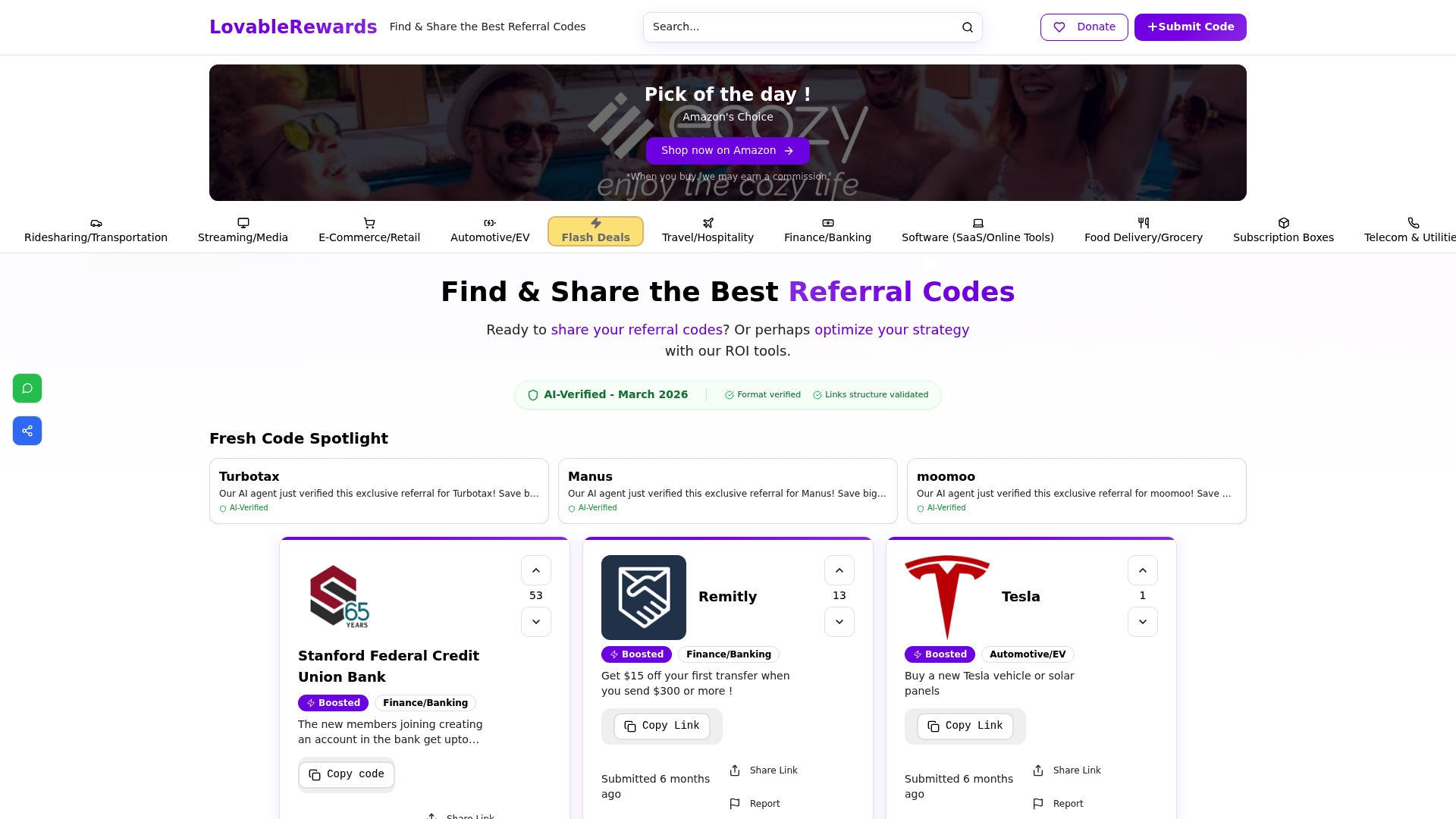
LovableRewards gives you access to AI-verified referral codes, live deal updates across e-commerce, fintech, and service platforms, and free tools built for deal hunters. Whether you are sharing codes or searching for the best active offer, the platform keeps everything organized and current. Start by reviewing the community guidelines to understand how codes are verified and rotated fairly. Then explore the full suite of free community tools including the ROI calculator and QR generator to sharpen your referral strategy and maximize every dollar.
Frequently asked questions
What counts as a 'qualifying action' for referral rewards?
A qualifying action is typically a first purchase, a deposit above a set minimum, or a verified account signup as defined by the specific referral program. Rewards activate post-qualifying action using dynamic discount codes tied to your account.
How do platforms prevent self-referral and fake accounts?
Platforms use device fingerprinting, IP address checks, email verification, and rate limits to block abuse. Self-referrals are blocked through fingerprint and email matching, with rewards held pending until payment clears.
Are community code aggregators safe to use?
They vary widely in reliability. Prioritize official apps and bank platforms for verified codes, and use aggregators only when they clearly display expiration dates and source information.
What if my referral reward is delayed or missing?
Check your account dashboard and look for a pending status first. If the reward is not credited within the stated window, contact support with your referral ID and proof of the qualifying action. Appeals processes exist to resolve false positives.
Can referral rewards be combined with cashback or coupon offers?
Yes, in most cases you can stack them. Stacking referrals with cashback platforms like Rakuten or BeFrugal is one of the most effective ways to maximize total savings, as long as the program terms do not explicitly prohibit it.