
TL;DR:
- Understanding referral program mechanics unlocks higher earning potential and improves success rates.
- Two-sided programs offer higher participation but carry increased fraud risks, necessitating careful review.
- Verified codes from trusted sources and communities help maximize savings and avoid fraudulent pitfalls.
Most people sharing referral codes leave real money on the table, not because the codes don't work, but because they don't fully understand how the system operates. Referral conversion rates hit 10-30%, dwarfing the 1-3% average for standard e-commerce. That gap represents enormous untapped value for anyone willing to learn the language of referral sharing. This guide breaks down the terminology, reward structures, and practical steps that separate deal hunters who consistently save from those who occasionally get lucky. Once you understand the mechanics, every code you share or redeem becomes a more deliberate, more rewarding action.
Table of Contents
- Core terminology in referral sharing explained
- Types of referral rewards: One-sided vs. two-sided
- How referral codes work: From sharing to redemption
- Mitigating risks: Fraud prevention and code validation
- Our perspective: Most people misuse referral programs, here's how savvy deal hunters get ahead
- Find and share verified referral codes with LovableRewards
- Frequently asked questions
Key Takeaways
| Point | Details |
|---|---|
| Know the terminology | Understanding key referral terms helps you avoid mistakes and maximize rewards. |
| Choose the right reward type | Two-sided programs offer greater rewards but require vigilance for fraud risks. |
| Follow best sharing practices | Verified communities and code validation are crucial for safe and effective referral use. |
| Leverage advanced tools | Referral calculators and strategic code rotation can further boost your savings. |
Core terminology in referral sharing explained
With the scale of referral effectiveness established, let's break down the key terms you'll encounter when seeking deals or promoting your codes.
The referral world has its own vocabulary, and getting it wrong costs you. A referrer is the existing user who shares a code. The referee is the new user who receives and acts on it. Sounds simple, but misidentifying your role in a program can mean claiming the wrong reward or missing one entirely. Start by reading referral codes explained to build a solid baseline before comparing offers.
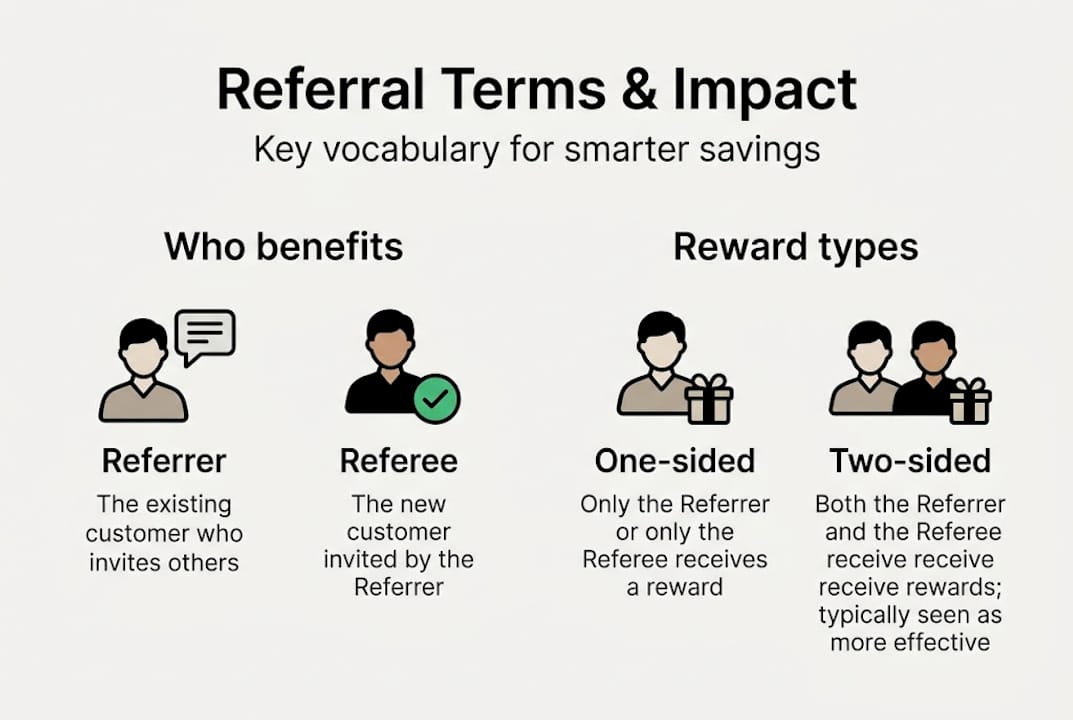
Beyond those two roles, a few terms shape how programs perform:
| Term | Definition | Why it matters |
|---|---|---|
| One-sided program | Only the referrer is rewarded | Lower cost for brands, less referral motivation |
| Two-sided program | Both parties receive a reward | Higher participation, more sharing incentive |
| Viral coefficient | Average new users each referrer brings in | Indicates how fast a program grows organically |
| Reward cap | Maximum reward a referrer can earn | Limits abuse and program cost |
| Fraud risk | Risk of fake referrals gaming the system | Affects code validity and program health |
| Verified code | Code tested and confirmed as active | Reduces wasted time on expired links |
Referred customers show 37% higher retention and convert at four times the rate of direct customers, which explains why brands invest so heavily in program design. Understanding types of referral programs helps you evaluate which offers are truly worth your effort.
Terms that are frequently misused or misunderstood:
- Viral coefficient is often confused with conversion rate. They measure different things: growth speed versus effectiveness per action.
- Reward cap is sometimes mistaken for an expiration date. It's actually a cumulative earnings limit, not a time limit.
- Verified code doesn't always mean "currently active." Always check the timestamp on verification.
- Fraud risk is underestimated by most casual users, who assume all losses fall on the brand rather than the community.
Pro Tip: Before sharing or using a code, confirm whether the program is one-sided or two-sided. If only the referrer benefits, the referee has no incentive to complete the action, which lowers your conversion rate significantly.
Types of referral rewards: One-sided vs. two-sided
Now that the core terminology is clear, you can better evaluate which reward methods best suit your goals.
The structure of a referral program determines whether people actually follow through. One-sided programs reward only the referrer, making them cheaper for companies to run but less compelling for new users. Two-sided programs share the benefit with the referee, creating a mutual incentive that drives action on both ends.

| Feature | One-sided | Two-sided |
|---|---|---|
| Who benefits | Referrer only | Referrer and referee |
| Participation rate | Lower | Significantly higher |
| Conversion rate | Moderate | Higher |
| Fraud risk | Lower | Higher without caps |
| Best use case | Loyal user base | New market acquisition |
Two-sided programs drive 2.4x to 3.2x higher participation, but that same generosity creates openings for abuse if the program isn't properly capped. A well-managed two-sided program with clear limits is usually the best environment for serious deal hunters.
When to prefer one type over the other:
- Choose one-sided if you're a referrer with a loyal audience who trusts your recommendations without needing a personal reward.
- Choose two-sided when targeting new users who need an extra reason to try something unfamiliar.
- Prefer capped two-sided programs when fraud prevention is a concern, since caps limit how much any single bad actor can extract.
- Look for uncapped one-sided programs if you have a large, high-converting audience and want maximum earning potential.
Spotting capped versus uncapped offers takes only a few seconds. Look for language like "earn up to $X" or "first 10 referrals only" in the program terms. Uncapped programs will typically say "unlimited" or avoid mentioning limits altogether. Use verified referral codes to find offers where the terms have already been reviewed so you're not hunting through fine print alone.
Pro Tip: Review the one-sided vs two-sided rewards breakdown before committing to any new program. Matching the right program type to your audience is one of the fastest ways to improve your referral results.
How referral codes work: From sharing to redemption
With an understanding of reward types, let's see how referral sharing actually works in practice and where the pitfalls often hide.
The referral process looks simple from the outside. You get a code, share it, and collect a reward. But each step has variables that can make or break your results. Understanding the full flow protects your time and maximizes your return.
- Discover the code. Find codes through trusted platforms, community groups, or directly from the issuing brand. Check multi-industry code examples to see how codes vary across sectors.
- Verify the code. Confirm the code is active, hasn't hit its redemption cap, and comes from a legitimate source.
- Share strategically. Match the code to the right audience. A fintech referral code performs best with people already interested in financial tools, not general shoppers.
- Track the status. Monitor whether referees complete the qualifying action, since most programs only pay out after a specific trigger like a first purchase or account funding.
- Claim your reward. Some rewards are automatic; others require manual redemption within a set window. Missing that window forfeits the reward.
- Rotate your codes. Don't rely on a single code indefinitely. Use the community code workflow to stay organized and keep your active codes fresh.
"Referral conversion rates can range from 10% to as high as 30%," according to referral program data, making a well-executed referral strategy one of the highest-performing tools in any deal hunter's toolkit.
Pro Tip: Code rotation is the habit most casual users skip and most experienced deal hunters swear by. When one code reaches its redemption limit, having a replacement ready means you never lose momentum or miss a savings window.
Mitigating risks: Fraud prevention and code validation
Maximizing savings also means understanding and avoiding potential risks in referral participation.
Fraud in referral programs is more common than most users expect, and the consequences aren't limited to brands. When fake referrals inflate a program, legitimate users often face tighter caps, shorter expiration windows, or program shutdowns entirely. Protecting yourself starts with knowing what to watch for.
Programs with uncapped two-sided rewards face higher fraud risk, which is why validation before sharing or using any code is a non-negotiable step for serious deal hunters. A compromised code doesn't just waste your time. It can disqualify your account from future rewards.
Top practices to avoid referral fraud:
- Verify the source first. Only use codes from platforms or communities with documented verification processes. A code posted anonymously on a random forum carries far more risk than one reviewed by a trusted community.
- Check for recent activity. A code shared six months ago with no recent redemption reports is a red flag. Look for codes with timestamps and community feedback.
- Avoid codes that promise outsized rewards. If a code claims to offer ten times the standard reward for the same program, it's likely fraudulent or already expired.
Verified communities reduce risk by crowdsourcing validation. When multiple users confirm a code works, the odds of it being fraudulent drop sharply. Review code rotation and fraud prevention tips to build a routine that keeps your participation clean.
Red flags worth noting: codes that ask for personal information beyond standard signup, links that redirect through unfamiliar domains, and programs that delay reward confirmation indefinitely. A legitimate program has clear terms, predictable payout timelines, and verifiable community feedback. When in doubt, cross-check with the referral community workflow to see how experienced users evaluate new codes before committing.
Our perspective: Most people misuse referral programs, here's how savvy deal hunters get ahead
After learning the essentials, consider this practical viewpoint for taking your referral game further.
Most users stick to one or two familiar programs and call it a referral strategy. That's actually a ceiling, not a strategy. The users who consistently extract the most value are the ones crossing industry lines, rotating codes actively, and treating referral participation like a portfolio rather than a single bet.
Conventional wisdom says chase the biggest reward. Our experience at LovableRewards says otherwise. Smaller, repeatable codes from multiple programs consistently outperform the pursuit of one large payout. The math is simple: five codes generating modest returns beat one code that hits its cap after two redemptions.
Engaging with trusted communities also changes the game. When you're plugged into verified networks, you hear about high-converting codes before they expire, not after. Review referral marketing tips for a practical framework, and use a referral ROI calculator to project which programs actually pay off before you invest your time.
Find and share verified referral codes with LovableRewards
Ready to put knowledge into action? Here's a trusted way to earn and save with confidence.
Everything covered in this guide works better when you have a reliable place to find and share codes. LovableRewards is built exactly for that purpose. The platform uses AI-based verification to confirm code validity before listing, so you're not guessing whether a deal is still active.
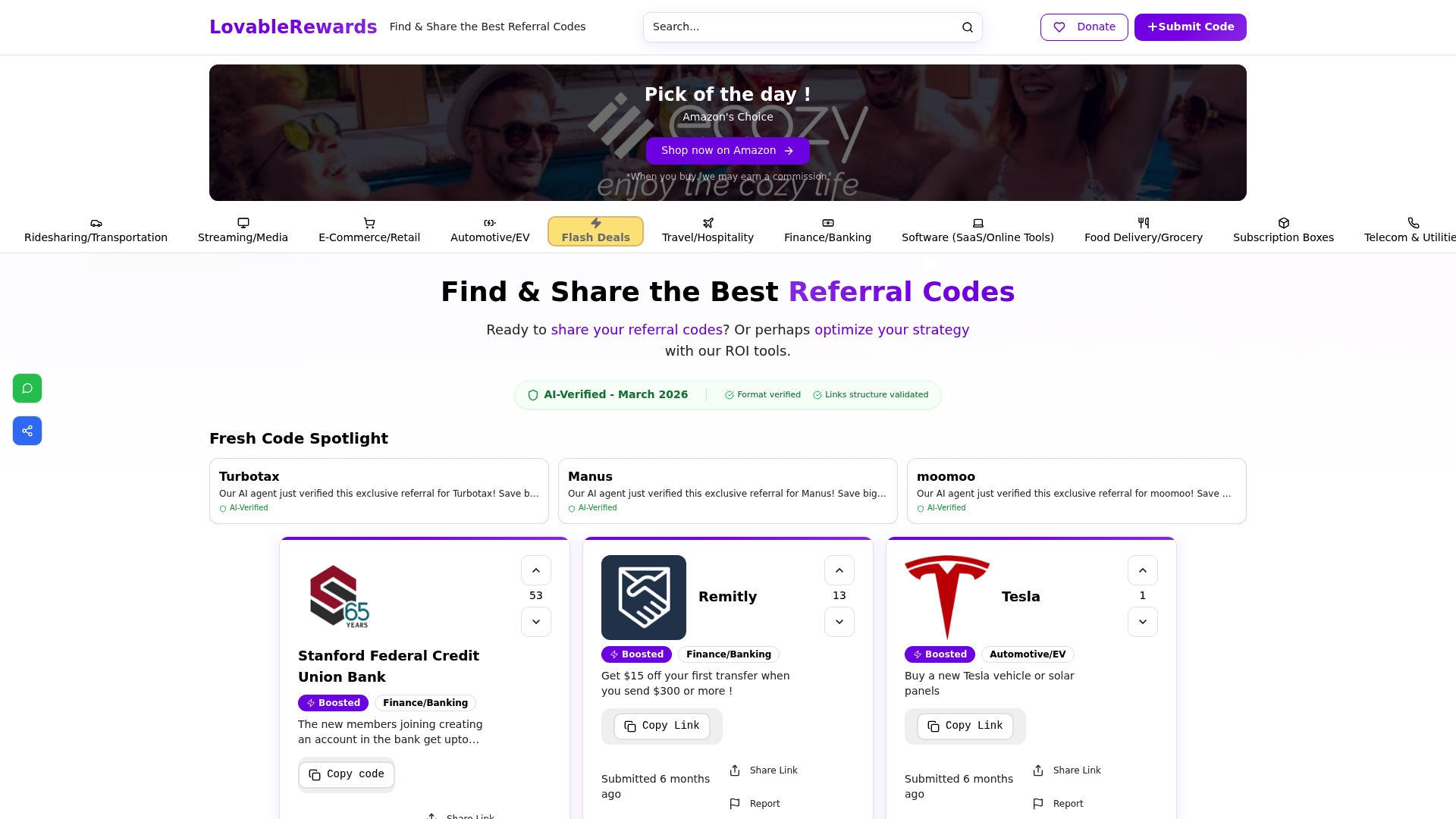
Whether you're a deal hunter searching for verified discounts or a referral marketer looking to maximize exposure for your own codes, the verified referral codes platform gives you a fair, transparent system. A rotation model ensures equal visibility for contributors, and community moderation adds a layer of trust that casual forums simply can't match. Start applying the strategies from this guide today and see the difference verified codes make.
Frequently asked questions
What does 'two-sided referral' mean in practice?
A two-sided referral rewards both the referrer and the new user, creating a mutual incentive that drives 2.4x to 3.2x higher participation but requires careful fraud management to stay sustainable.
How can I tell if a referral code is verified?
Verified codes come from reputable sources, have been actively tested, and carry community or platform confirmation of their current validity and terms.
Why do some referral codes have caps or expiration dates?
Caps and expirations protect program integrity by limiting abuse. Programs need caps to mitigate the elevated fraud risk that comes with two-sided reward structures.
What is the average success rate when using referral codes?
Referral programs regularly achieve conversion rates of 10-30%, which is dramatically higher than the 1-3% typical of standard e-commerce channels.
Is sharing codes in communities safer than sharing alone?
Yes. Reputable communities validate codes collectively, reducing the chance of expired or fraudulent codes reaching your audience and protecting your account standing in the process.