
TL;DR:
- Two-sided referral programs reward both participants, leading to higher engagement and retention.
- Simple, audience-specific rewards outperform complex gamification strategies over the long term.
- Matching reward types to target audiences and leveraging verified, real-time code platforms maximizes referral success.
Not every referral program is built the same, and picking the wrong type can mean leaving serious money on the table. Whether you're a consumer hunting for verified discounts or a marketer trying to maximize reach, the sheer number of program structures out there can feel overwhelming. Some programs reward only the person sharing the link. Others split the benefit between both parties. Some pay cash, others give credits or unlock features. Understanding the mechanics behind each type is the fastest way to stop guessing and start earning more from every referral you make or promote.
Table of Contents
- How to evaluate referral programs: Key criteria and decision points
- One-sided vs. two-sided: Referral reward structures explained
- Types of referral programs by audience: Customer, affiliate, partner, and employee
- Reward structures and mechanics: How incentives really work
- Side-by-side comparison: Which referral type is right for you?
- Why simple, audience-first referral programs win out
- Find and maximize top referral programs with LovableRewards
- Frequently asked questions
Key Takeaways
| Point | Details |
|---|---|
| Choose the right reward structure | Two-sided programs and tailored incentives drive the highest engagement and ROI. |
| Match rewards to your audience | Consumers prefer credits or discounts, pros get more value from cash or commissions. |
| Check program mechanics | Frictionless sharing and easy tracking are crucial for both participation and rewards. |
| Compare types before joining | A quick side-by-side overview can help you select the best-fit referral program for your needs. |
How to evaluate referral programs: Key criteria and decision points
Before comparing types, you need a clear lens for judgment. Not all referral programs deliver equal value, and the right fit depends on your specific goals, whether that's saving money as a consumer or scaling reach as a marketer.
Start by asking these core questions:
- Reward type: Is the incentive cash, store credit, a discount, or a feature unlock? Each serves a different purpose.
- Entry barrier: Does joining require a purchase, a sign-up, or nothing at all?
- Transparency: Are the terms clear? Is there a defined expiration or minimum threshold?
- Tracking method: Does the program use unique links, codes, or cookies to attribute referrals?
- Reward timing: Do you get paid immediately after sign-up, or only after the new user completes a qualifying action?
The typical referral journey moves through five stages: enrollment, link or code generation, sharing, qualification event (like a first purchase), and reward delivery. Each stage is a potential drop-off point. Programs that make these stages frictionless tend to perform far better.
Decision points also include who gets rewarded. Some programs only pay the person who refers. Others split the reward. And a few programs reward the new customer exclusively to drive acquisition. Knowing this upfront shapes how you share and who you target.
Pro Tip: Use a referral program revenue calculator to estimate your expected return before committing to any program. It takes the guesswork out of comparing options.
The numbers back up the importance of smart selection. Referral programs deliver 3.5 to 8x ROI and can cut customer acquisition costs by up to 50% when you choose wisely. That's not a small margin. Picking the right structure from the start compounds over time.
One-sided vs. two-sided: Referral reward structures explained
The most fundamental split in referral program design is whether the reward goes to one person or two. This single decision shapes everything from engagement rates to cost-per-acquisition.
One-sided programs reward only one party, either the referrer or the new customer. A company might give the referring user a $10 credit but offer nothing to the person they invited. Or they might attract new users with a welcome discount while giving the referrer nothing. These programs are simpler to manage and cheaper to run, but they often see lower sharing motivation.
Two-sided programs reward both the referrer and the new customer. The referrer gets credit or cash, and the new user gets a discount or bonus for joining. This creates a mutual incentive that makes sharing feel natural and generous rather than self-serving.
Here's a quick comparison:
| Feature | One-sided | Two-sided |
|---|---|---|
| Who gets rewarded | Referrer or referee only | Both parties |
| Sharing motivation | Moderate | High |
| Cost to brand | Lower | Higher |
| Engagement rate | Average | Highest |
| Best use case | Acquisition push | Retention and growth |
The data is clear. Two-sided programs represent over 90% prevalence among top-performing referral campaigns and consistently show the highest engagement rates. That's not a coincidence.
When both people win, the referrer has a genuine reason to share, and the new customer has a real reason to act. The friction drops on both sides.
Benefits of two-sided programs include:
- Higher conversion rates from invites to sign-ups
- Stronger trust signals since the referrer is also vouching for the deal
- Better long-term retention because both users feel valued from day one
For a deeper look at how community-driven structures apply these principles, explore community referral structures in practice.
Types of referral programs by audience: Customer, affiliate, partner, and employee
Beyond reward structure, referral programs also vary by who participates. Each audience type brings different motivations, and the best programs are designed with that in mind.
Customer referral programs (B2C): These target everyday buyers. A customer shares a code with a friend, and both get a reward when the friend makes a purchase. E-commerce, subscription services, and fintech apps dominate this space. Rewards are typically credits, discounts, or cashback.

Affiliate programs: These are built for content creators, bloggers, and marketing professionals. Affiliates promote a product to their audience and earn a commission per sale or sign-up. Affiliate and partner programs typically offer commissions of 15 to 30% recurring or $25 to $200 one-time, and they're most common in SaaS and B2B.
Partner and reseller programs (B2B): These involve businesses referring other businesses. A software company might partner with a consultancy that recommends their tool to clients. Rewards are often revenue shares or co-marketing benefits.
Employee referral programs: These are internal hiring tools. Employees refer candidates for open roles and receive a bonus if the hire is made and retained. Common in tech, healthcare, and professional services.
| Program type | Best industry | Typical reward | Mechanics |
|---|---|---|---|
| Customer | E-commerce, fintech | Credits, discounts | Unique codes/links |
| Affiliate | SaaS, media | Cash commission | Tracked links |
| Partner/reseller | B2B, software | Revenue share | CRM integration |
| Employee | Tech, healthcare | Cash bonus | HR platform |
Pro Tip: Credits and discounts work best for consumer audiences because they keep spending within the ecosystem. Cash is the right choice for professional affiliates who need tangible income from their promotional work. Matching reward type to audience is a core performance lever. See how the community referral workflow applies this logic in real scenarios.
Reward structures and mechanics: How incentives really work
Knowing the program type is only half the picture. The reward structure and the mechanics behind delivery are what determine whether a program actually converts.
Common reward forms include:
- Cash payouts: Direct deposits or PayPal transfers. High motivation for affiliates and professionals.
- Store credits or discounts: Redeemable on future purchases. Cost-effective for brands because the margin stays in-house.
- Feature unlocks: Common in SaaS. Refer five users and get access to a premium feature. Low cost, high perceived value.
- Tiered or milestone rewards: Earn more as you refer more. Motivating for power users but can confuse casual participants.
- Points systems: Accumulate points redeemable for various rewards. Works well in loyalty-heavy industries.
- Charitable donations: The brand donates on your behalf. Appeals to mission-driven audiences.
Credits and discounts are optimal for customer retention, while recurring commissions work best for affiliates who are investing real time and effort into promotion.
On the mechanics side, most programs rely on unique referral links or codes tied to a specific user. When that link is clicked or code entered, the system logs the attribution. Qualification events, like a first purchase or a 30-day subscription, then trigger the reward automatically.
Pro Tip: Keep tiered and milestone structures as simple as possible. If a user needs to read three paragraphs to understand how to earn their next reward, you've already lost them. One clear threshold beats five confusing tiers every time.
For a breakdown of which incentive structures perform best by industry, check out optimal referral incentives to see current data-driven recommendations.
Side-by-side comparison: Which referral type is right for you?
With all the options laid out, a direct comparison makes the decision much easier.
| Program type | Best for | Reward type | Engagement | ROI potential |
|---|---|---|---|---|
| One-sided (referrer) | Acquisition campaigns | Cash or credit | Moderate | Medium |
| One-sided (referee) | New user growth | Welcome discount | Low to moderate | Low to medium |
| Two-sided | Retention and growth | Credits + discount | Highest | High |
| Affiliate | Content marketers | Cash commission | High | High |
| Partner/B2B | Business growth | Revenue share | Moderate | Very high |
| Employee | Internal hiring | Cash bonus | Moderate | High |
Referred customers show 37% higher retention and deliver up to 8:1 ROI compared to non-referred customers. That stat alone makes a strong case for prioritizing referral programs over paid ads in many scenarios.
Here's a quick decision checklist:
- You're a consumer seeking discounts: Look for two-sided customer programs with immediate credit rewards.
- You're a content creator or blogger: Affiliate programs with recurring commissions offer the best long-term income.
- You run a B2B business: Partner programs with revenue sharing align incentives with mutual growth.
- You're hiring: Employee referral programs with tiered bonuses reduce time-to-hire and improve quality.
- You want simplicity: Two-sided programs with a single reward event are easiest to manage and explain.
For those managing multiple codes across programs, referral code rotation strategies can help you stay organized and maximize visibility without overlap.
Why simple, audience-first referral programs win out
Here's something most guides won't tell you: the most technically sophisticated referral program is rarely the most effective one. We've seen brands build elaborate gamification systems with badges, leaderboards, and five-tier milestone structures, only to watch engagement crater after the first month. The novelty wears off. The complexity stays.
The programs that consistently outperform are the ones that match one clear reward to one specific audience. A consumer who shops weekly doesn't need a points dashboard. They need a $10 credit they can use next Tuesday. A professional affiliate doesn't want store discounts. They want a predictable commission that shows up in their bank account.
Consumer behavior also shifts. A reward that worked in 2024 might feel underwhelming in 2026. The brands that win long-term treat their referral programs as living systems, testing new reward types, adjusting thresholds, and listening to community feedback. Platforms that aggregate verified referral codes provide real-time signals about which programs are gaining traction and which are losing steam. That kind of data is worth more than any static best-practice guide.
Simplicity is not laziness. It's the highest form of program design.
Find and maximize top referral programs with LovableRewards
Ready to put these insights into action? LovableRewards makes it easy to find, compare, and use the best referral programs across every major industry.
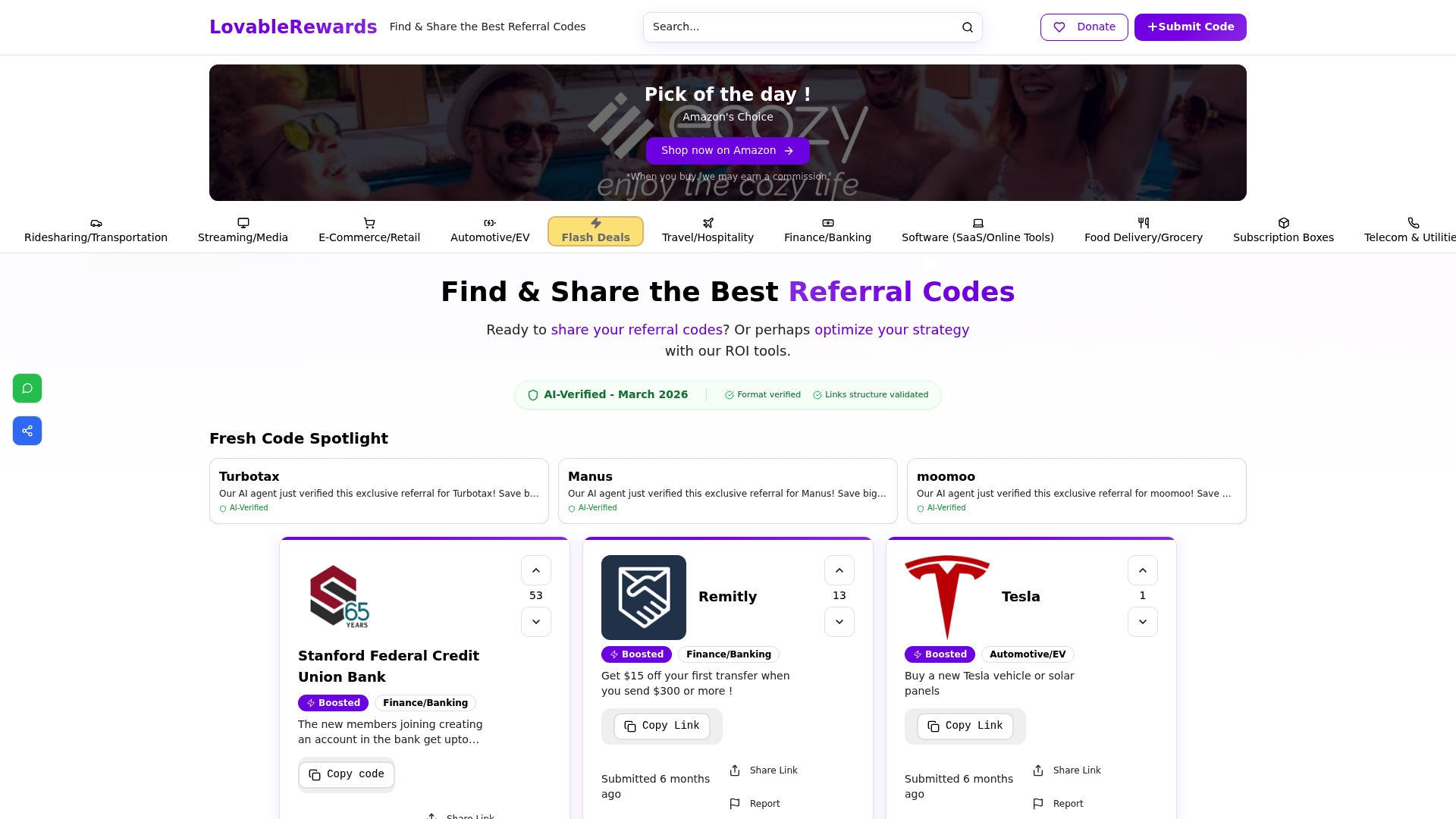
The platform aggregates working referral codes from e-commerce, fintech, SaaS, and transportation, all screened by AI verification to confirm validity before you ever click. No expired codes. No scam links. Just real, working deals from a community of active contributors. You can also use the referral ROI calculator to estimate your earnings before committing to any program. Whether you're a deal hunter or a marketer building exposure for your own codes, LovableRewards gives you the tools and the community to make every referral count.
Frequently asked questions
What type of referral program offers the highest engagement?
Two-sided referral programs, which reward both the referrer and the new customer, consistently show the highest engagement rates and represent over 90% of top-performing campaigns.
Are credits and discounts better for referral rewards than cash?
Credits and discounts are more cost-effective for consumer audiences because they keep value within the brand ecosystem, while cash works best for professional affiliates who need direct income.
What are typical conversion rates for referral program links?
Referral links convert 13 to 16% of invites into purchases, which is up to 16 times higher than traditional digital advertising conversion rates.
Which industries use referral programs the most?
E-commerce, SaaS, and B2B sales are the leading industries for referral program adoption, offering the widest variety of reward structures and the highest volume of active programs.
How can I track the ROI of my referral program?
Use referral revenue calculators and dedicated tracking tools to measure conversion rates, customer acquisition costs, and long-term ROI across your active programs.