
TL;DR:
- Referral codes are personalized, built on trust, and track customer relationships for loyalty.
- Promo codes are broadly distributed, used for quick sales boosts without personalized attribution.
- Combining both strategies sequences reach and loyalty, maximizing long-term growth and savings.
Most people treat referral codes and promo codes as the same thing. Toss a code into checkout, get a discount, move on. But that assumption costs you real money and, if you're a marketer, real results. These two code types work through completely different mechanics, serve different goals, and produce different outcomes for both shoppers and brands. Once you understand how each one actually functions, you can stop leaving rewards on the table and start using the right code at exactly the right moment. This article breaks down the definitions, the key distinctions, and what the data says about which code performs better and when.
Table of Contents
- What are referral and promo codes?
- Key differences between referral and promo codes
- Benefits and drawbacks for consumers
- Impacts on marketers: Conversion, loyalty, and costs
- A smarter approach: When and how to use each code type
- Unlock more savings and smarter rewards with LovableRewards
- Frequently asked questions
Key Takeaways
| Point | Details |
|---|---|
| Different code purposes | Referral codes reward sharing and track individual relationships; promo codes boost widespread sales with broad discounts. |
| Consumers can maximize value | Combining or timing the right codes can increase savings and rewards for shoppers. |
| Marketers drive better ROI | Referral programs usually lower costs and build loyal customers, while promo codes create fast, broad reach. |
| Use both strategically | Savvy brands and shoppers benefit most by using both types in the right scenario. |
What are referral and promo codes?
Let's get the definitions straight before comparing them, because the confusion usually starts here.
A referral code is a unique identifier tied to a specific person, typically an existing customer or affiliate. When you sign up for a service using someone's referral code, that code links your account directly to theirs. Both parties often receive a reward: the referrer gets credit, cashback, or a free month, and the new user gets a welcome bonus. The whole system is built around tracking who brought whom to the platform. You can explore referral code basics to see how these codes are structured across different industries.
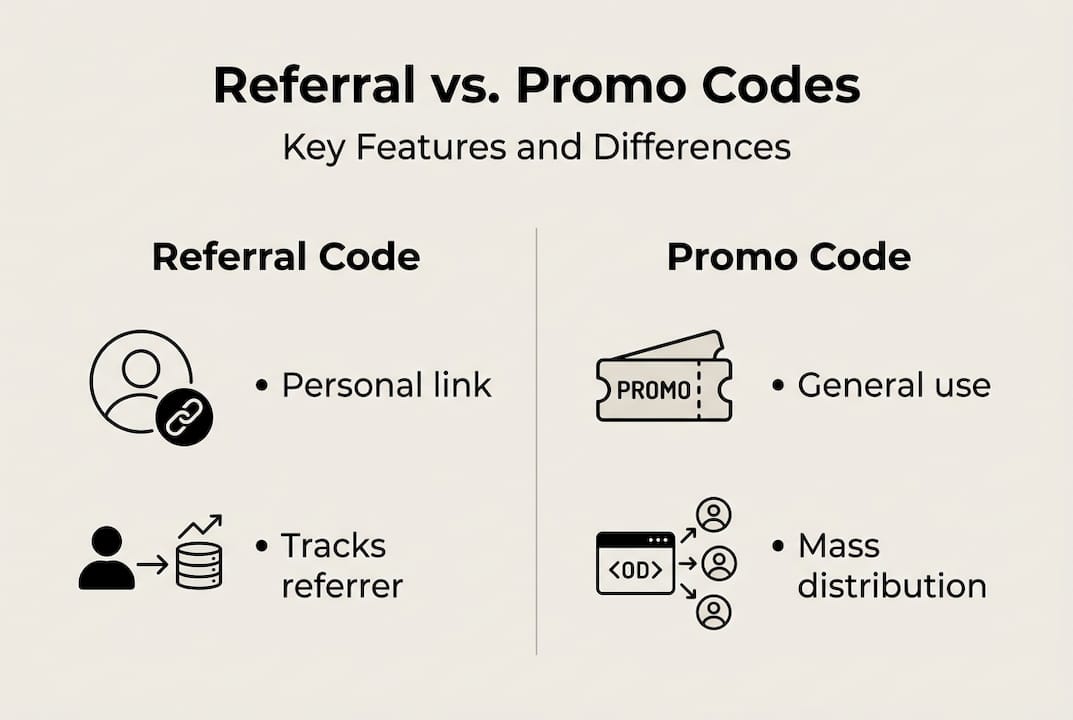
A promo code works differently. It's a general discount code, usually a short alphanumeric string, distributed broadly through email campaigns, social ads, or coupon sites. Promo codes are general discount alphanumeric codes for broad marketing campaigns. Anyone with the code can use it. There's no connection to a specific sender, and brands use them to drive short-term spikes in sales or attract new customers at scale.
Here's a quick-reference comparison of the two:
| Feature | Referral code | Promo code |
|---|---|---|
| Who gets it? | Specific users or customers | General public |
| Is it personalized? | Yes, tied to a person | No |
| Who benefits? | Referrer and new user | New user only |
| How is it shared? | Personally (friend to friend) | Mass campaigns |
| Tracking capability | High (tracks referral chain) | Low (no attribution) |
| Reward type | Credits, cashback, bonuses | Flat discount or percentage off |
The key thing to notice: referral codes create a relationship. Promo codes create a transaction. Referral codes leverage trust for higher-quality customer acquisition precisely because the recommendation comes from someone the new user already knows.
Some common examples:
- A friend sends you their Uber referral code, and you both get ride credit.
- A clothing brand emails "SUMMER20" to everyone on their list for 20% off.
- A fintech app rewards existing users with $10 when their referral signs up and makes a first deposit.
- A SaaS company runs a promo code for 30% off during a product launch.
The real-world use cases feel similar on the surface, but the underlying logic and business impact are quite different.
Key differences between referral and promo codes
Now that you know what referral and promo codes are, let's see how they actually differ where it matters most.
The clearest distinction is distribution. Referral codes travel person to person, usually through a direct message, an email, or a social post from someone you trust. Promo codes get blasted out to hundreds of thousands of people at once. That distribution gap alone changes everything: the reach of a promo code is massive, but the trust behind a referral code is far more powerful.
Attribution is another major gap. When someone uses your referral code, the brand knows exactly who sent that customer. That data feeds back into loyalty programs, tiered rewards, and long-term customer profiles. Promo codes are mostly anonymous at the point of use. Brands can track redemption volume, but they rarely know why a customer decided to buy or who influenced them.

There's also a difference in the size and reliability of rewards. Referral programs often offer more generous incentives because the brand is paying for a qualified lead from a trusted source. Promo codes are designed to lower friction, not necessarily to reward loyalty. Referral code benefits often stack up over time in ways a one-time promo code discount simply can't match.
Here's a direct comparison across the dimensions that matter most:
| Dimension | Referral code | Promo code |
|---|---|---|
| Trust level | High (peer recommendation) | Low (mass marketing) |
| Customer quality | Higher retention, better LTV | Variable |
| Attribution | Precise | Limited |
| Reward generosity | Often larger | Usually modest |
| Campaign goal | Loyalty, acquisition | Volume, urgency |
| Abuse risk | Lower | Higher |
A useful stat: 92% of consumers look for deals with promo codes, confirming their reach. But referrals build longer-term loyalty that promo codes simply can't replicate.
When one is preferable over the other:
- Use a referral code when you want a trusted recommendation, recurring rewards, or loyalty-building benefits.
- Use a promo code when you need a fast discount and don't have a personal connection to an existing user.
- Referral codes are better for ongoing savings across subscriptions, fintech, or ride-sharing apps.
- Promo codes shine for one-off purchases, seasonal events, or first-time category exploration.
You can also find referral codes for current offers shared by real users across dozens of categories, which is faster than waiting for a brand to send you one directly.
Benefits and drawbacks for consumers
Beyond abstract differences, let's look at what these codes mean for your wallet and overall shopping experience.
Promo codes are easy wins. You search, you apply, you save. No relationship required. But they come with strings: expiration dates, minimum spend thresholds, category exclusions, and single-use limits. You might find the perfect code only to discover it expired two days ago. Always check referral code expiration policies because both code types can go stale faster than most people expect.
Referral codes require a bit more setup but often deliver stronger results. The rewards are frequently larger, and they can be recurring rather than one-time. More importantly, referred customers have 37% higher retention and 30% higher conversion than customers acquired through other channels. That means the brands investing in referral programs are getting genuinely loyal buyers, not just one-off deal hunters.
Here's a side-by-side user journey for each:
- Promo code journey: Search for a code online -> find one on a coupon site -> paste it at checkout -> get a flat discount -> done.
- Referral code journey: Receive a personalized code from a trusted contact -> sign up or make a purchase -> both you and the referrer earn rewards -> earn more rewards each time you refer others.
The referral journey has more steps upfront but compounds over time. The promo code journey is frictionless but ends the moment you close your browser.
"The best savings strategy isn't choosing between referral and promo codes. It's knowing which one to reach for depending on your goal."
Pro Tip: Some platforms let you stack a referral code with a promo code at checkout. It's worth testing both fields before finalizing any order. You can also optimize referral workflow by timing your referral code use around promotional periods, essentially doubling your discount window.
Impacts on marketers: Conversion, loyalty, and costs
Having looked at the consumer side, what about marketers deciding which code to deploy?
Referral programs are consistently among the highest-ROI acquisition channels available. Referral programs lower CAC by 30 to 50%, yield 16% higher customer lifetime value, and produce conversion rates 3 to 5 times higher than other channels. Those numbers aren't marginal improvements. They're the kind of gains that change budget allocation decisions.
Dropbox is the canonical example. The company grew its user base by 3,900% in 15 months primarily through a referral program offering free storage to both referrer and new user. No massive ad spend, just peer trust amplified at scale.
Promo codes can move the needle fast on sales volume, but they come with a hidden cost: leakage. Untracked codes get shared across coupon forums, reused beyond their intended limit, and sometimes abused by bot networks. Brands running large promo code campaigns often see redemption rates that look great on paper but deliver thin margins and one-time buyers who never return.
When to use each in your marketing strategy:
- Referral codes: New user acquisition, subscription products, loyalty programs, community building.
- Promo codes: Product launches, seasonal sales, cart abandonment recovery, re-engagement campaigns.
- Referral codes: When your existing customer base is strong enough to serve as a distribution channel.
- Promo codes: When speed and reach matter more than long-term relationship quality.
To keep your referral program healthy over time, study referral code rotation tactics that prevent abuse while keeping engagement high. You can also explore referral marketing tips and types of referral programs to find the model that fits your business.
Pro Tip: Run a promo code campaign to drive initial traffic, then layer a referral program on top for users who convert. This sequence captures both the volume benefit of promo codes and the retention benefit of referrals. Use a referral ROI calculator to model the expected return before you launch.
A smarter approach: When and how to use each code type
Here's the perspective most articles skip: the real mistake isn't using the wrong code type. It's thinking you have to pick just one.
Smart brands map code types to customer journey stages. Promo codes lower the barrier to entry at the top of the funnel. A first-time visitor who sees a 15% off code is more likely to take the plunge. Once that customer has a positive experience, a referral program turns them into a distribution channel. You're not choosing between reach and loyalty. You're sequencing them.
Dropbox didn't just offer referral incentives. It used launch promotions to build initial awareness, then let referrals compound that growth. Most brands do the opposite: they run endless discount campaigns and wonder why their customer base is shallow.
The uncomfortable truth is that promo codes are often used as a shortcut when a brand hasn't built enough trust to earn referrals organically. Referrals require a product people actually want to talk about. Promo codes don't. That distinction matters strategically. Build community referral code strategies into your marketing calendar from day one, not as an afterthought after the promo budget runs out.
Unlock more savings and smarter rewards with LovableRewards
If you want to get the most rewards out of every purchase or campaign, here's where to start.
LovableRewards makes it easy to find, share, and verify both referral and promo codes across dozens of industries, including e-commerce, fintech, and transportation. Every code on the platform is AI-verified for validity, so you're not wasting time on expired or fake offers.
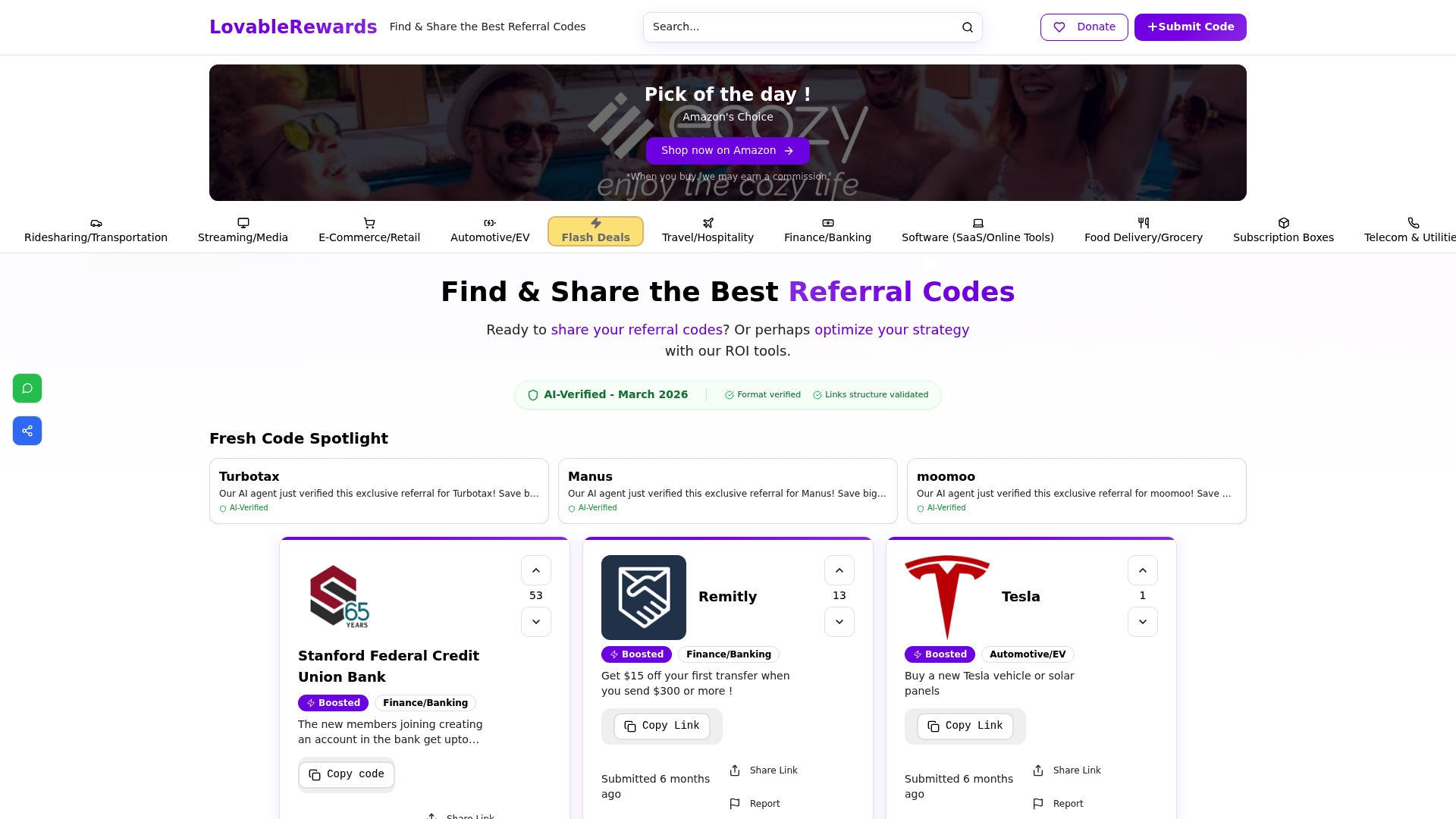
Whether you're a consumer hunting for the best deal or a marketer looking to benchmark your referral program, start earning with LovableRewards and put verified codes to work immediately. You can also revisit the fundamentals anytime by reading how to unlock referral savings and apply them across your favorite brands.
Frequently asked questions
Can you use referral and promo codes together?
Some retailers allow code stacking, but it's best to check each brand's checkout policy before assuming both fields will apply.
Why do referral codes sometimes offer bigger rewards than promo codes?
Referral codes are personalized and incentivize loyal customers, so brands offer more generous rewards to reflect the higher quality of the lead. Referral codes drive higher customer retention and conversion, which justifies the larger incentive.
Are promo codes always public, and are referral codes always private?
Promo codes are generally used for public marketing campaigns, while referral codes are typically private but can be shared more broadly depending on the program's rules.
Which type of code is better for marketers?
Referral codes usually deliver more loyal customers and lower acquisition costs, but promo codes can quickly boost sales volumes. Referral programs lower CAC by 30 to 50% and boost lifetime value by 16%, making them stronger for long-term ROI.
Do referral codes expire like promo codes?
Both can expire, but the timeline depends entirely on the program's policy, so consumers should always check terms before sharing or redeeming either type.