
TL;DR:
- AI verifies over a million discount codes daily, improving accuracy and speed over manual methods.
- Machine learning predicts code validity, expiry, and detects fraud through real-time and historical data analysis.
- Combining AI testing with community feedback ensures up-to-date, reliable, and fraud-resistant coupon verification.
AI now verifies over a million discount codes every single day, blending real-time technology with human input to deliver accuracy that manual methods never could. If you've ever pasted a coupon code only to see it fail at checkout, you know the frustration. The good news is that multi-step verification processes including real-time merchant testing, machine learning pattern recognition, and community feedback loops are changing that experience fast. For deal hunters and referral marketers, understanding how this technology works means smarter choices, fewer wasted clicks, and more actual savings.
Table of Contents
- The evolution of code verification: From manual checks to AI-driven accuracy
- How machine learning predicts code validity and adapts to retailer rules
- Handling edge cases and fraud: AI's defense against code abuse
- AI and community: The feedback loop that keeps codes fresh and reliable
- Why real-time AI verification is the deal hunter's best friend (but not a silver bullet))
- Unlock more verified codes and community-powered rewards
- Frequently asked questions
Key Takeaways
| Point | Details |
|---|---|
| AI tests codes in real time | Artificial intelligence actively checks coupon codes against merchant systems for faster, accurate validation. |
| Machine learning spots patterns | AI models predict code validity by recognizing retailer rules, seasonal formats, and likely expiration dates. |
| Fraud prevention is built-in | Rule-based systems and pattern analysis help AI flag suspicious activity and mitigate abuse. |
| Community keeps codes fresh | Hybrid feedback loops with user reports enable platforms to catch expired or invalid codes promptly. |
The evolution of code verification: From manual checks to AI-driven accuracy
Not long ago, coupon verification was almost entirely reactive. Platforms scraped codes from retailer pages, users submitted codes they found online, and the community voted on what worked. If a code expired, it often stayed live until enough people complained. That lag time cost users real money and trust.
Manual verification had a ceiling. A human team can realistically check hundreds of codes per day. There's no way to keep pace with the thousands of new promotions launched every 24 hours across e-commerce, finance, travel, and beyond. The process was slow, inconsistent, and prone to gaps.
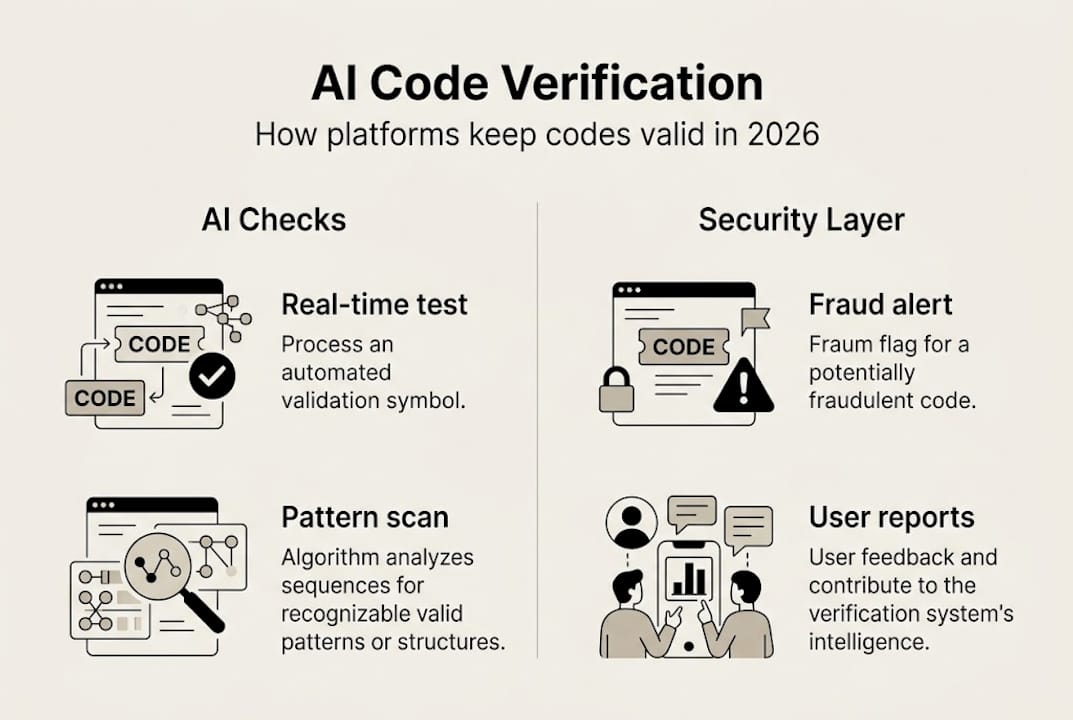
AI changed the equation entirely. Modern systems shift from passive scraping to active testing, processing over 1 million codes per day with machine learning accuracy across e-commerce and beyond. That's not just faster, it's a fundamentally different approach.
Here's a direct comparison of how the two methods stack up:
| Feature | Manual verification | AI-driven verification |
|---|---|---|
| Speed | Hundreds per day | 1M+ codes per day |
| Accuracy | Inconsistent, user-dependent | Pattern-trained, predictive |
| Fraud detection | Minimal | Real-time anomaly detection |
| Expiry tracking | Delayed | Automated, timestamp-based |
| Scale | Limited | Cross-industry, global |
The improvements AI brings to the table are significant and practical:
- Real-time testing against live merchant checkout systems catches failures the moment they happen
- Pattern recognition identifies code formats before even testing them
- Predictive expiry modeling flags codes likely to expire soon based on historical data
- Cross-retailer learning allows the system to apply rules from one store to similar retailers
- Hybrid feedback integration merges automated checks with community reports for layered accuracy
For a practical walkthrough of how this works end-to-end, the step-by-step code validation process breaks it down clearly. You can also browse verified deals with AI to see these principles applied in real time.
How machine learning predicts code validity and adapts to retailer rules
Machine learning doesn't just check if a code works today. It predicts whether it will work tomorrow, next week, or for a specific type of buyer. That's a meaningful distinction for anyone serious about maximizing savings.
Models trained on millions of redemptions learn to detect patterns like seasonal formats, retailer-specific rule sets, and expiration signals based on historical data. A code that looks valid on the surface might carry structural markers that indicate it's a single-use format, a loyalty-tier exclusive, or a region-locked offer.
Here's how the prediction workflow typically operates:
- Code ingestion — The system receives a new code via scraping, user submission, or API feed
- Format analysis — Machine learning classifies the code by structure, length, and character pattern
- Retailer rule matching — The code is cross-referenced against known rules for that merchant
- Historical comparison — Similar codes from the same retailer are pulled to estimate validity window
- Live checkout test — The code is tested against the merchant's actual checkout environment
- Score assignment — A health score and verification timestamp are assigned and displayed
This process allows platforms to catch mismatches before users even see a code. Consider how this plays out across industries:
| Code type | AI detection signal | Outcome |
|---|---|---|
| Seasonal flash sale | Short validity window pattern | Flagged as expiring soon |
| First-time user only | Single-redemption marker | Labeled as restricted |
| Region-locked offer | IP-based rule mismatch | Excluded from non-eligible users |
| Stacking-restricted | Multi-code conflict detection | Blocked from combination use |
Understanding how code verification protects savings gives you a stronger foundation for evaluating which platforms actually deliver on their promises. You can also explore multi-industry code examples to see how these rules differ across sectors.
Pro Tip: Always prioritize platforms that display a verification timestamp and a health score next to each code. A code verified 3 weeks ago is not the same as one verified 3 hours ago.
Handling edge cases and fraud: AI's defense against code abuse
Machine learning is impressive for standard verification, but the real test of any system is how it handles abuse. Coupon fraud is not a minor inconvenience. It's a billion-dollar problem that costs retailers and honest deal hunters alike.

According to industry estimates, coupon fraud costs businesses approximately $2.8 billion annually. That figure includes bot-driven mass redemptions, enumeration attacks where bots generate thousands of code variations to find valid ones, and over-redemption schemes where a single-use code gets exploited at scale.
Common fraud types that AI systems must handle include:
- Bot activity spikes — Unusual off-peak redemption volumes that signal automated abuse
- Enumeration attacks — Rapid sequential code testing to discover valid combinations
- Over-redemption — Single-use codes redeemed multiple times through account manipulation
- Code stacking — Combining codes in ways that violate retailer terms
- Suspicious IP clusters — Multiple redemptions from the same IP or device fingerprint
AI defenses work on multiple fronts simultaneously. Rule-based AI validation flags high-risk codes from suspicious IPs and blocks multiple codes from stacking when retailer rules prohibit it. This kind of structured rule enforcement runs alongside machine learning anomaly detection for a layered defense.
For referral marketers, understanding these defenses matters because fraud directly threatens your code's visibility and reputation. Platforms that prevent fraud with code rotation and enforce code rotation fairness protect both contributors and consumers from abuse.
Pro Tip: Look for platforms that show real-time fraud alerts or flag codes with unusual redemption velocity. That transparency tells you the system is actively working, not just passively listing codes.
AI and community: The feedback loop that keeps codes fresh and reliable
AI is powerful, but it isn't omniscient. Retailer-side changes, flash sales that end early, and geo-specific restrictions can all create gaps between what AI predicts and what actually happens at checkout. That's where community feedback becomes essential.
The smartest platforms treat AI and community input as partners, not competitors. When a user reports a code as expired or invalid, that signal triggers an immediate retest cycle. The hybrid AI-community feedback loop combines real-time merchant testing with crowd-sourced accuracy checks for a result no single method achieves alone.
The benefits of this hybrid approach are concrete:
- Faster staleness detection — Community flags surface problems before the next scheduled AI retest
- Retailer-specific nuance — Users often know exclusions that AI hasn't yet learned
- Cross-industry coverage — Community members span industries, catching edge cases at scale
- Trust building — Transparent feedback loops make users more confident in the codes they use
- Continuous model improvement — User reports feed back into machine learning training data
"Combining AI-driven testing with community feedback creates a verification ecosystem where errors are caught faster, codes stay fresher, and users develop genuine trust in the platform's reliability." — LovableRewards editorial team
Transparency is the linchpin of this system. Displaying verification timestamps, health scores, and community report counts gives users the context to make informed decisions. Community moderation for deals explains how this process works in practice, and verified community rewards shows what it looks like when both systems fire together.
Why real-time AI verification is the deal hunter's best friend (but not a silver bullet)
Here's the honest take: AI verification is the single biggest improvement in deal hunting in the past decade. It saves you from wasted checkout attempts, filters out dead codes before you see them, and scales across industries in ways no human team ever could. For referral marketers, it means your valid codes get surfaced and your reputation stays intact.
But treating AI as infallible is a mistake. AI excels at scale but struggles with real-time data staleness and retailer-specific exclusions that change without notice. A code verified at 9 a.m. might be dead by noon if a flash sale ends early. No model predicts that perfectly.
The savvy move is to combine platform intelligence with your own habits. Check verification timestamps before using a code. Report codes that fail so the system learns faster. Prioritize platforms that show health scores, not just a green checkmark. And when you find a code that works, share it. That contribution improves accuracy for everyone.
For avoiding the most common pitfall, the guide on avoiding expired codes is worth bookmarking. The best deal hunters treat AI as a powerful tool, not a guarantee.
Unlock more verified codes and community-powered rewards
If you want to put these insights to work and maximize your savings with AI-verified codes, LovableRewards is built for exactly that.
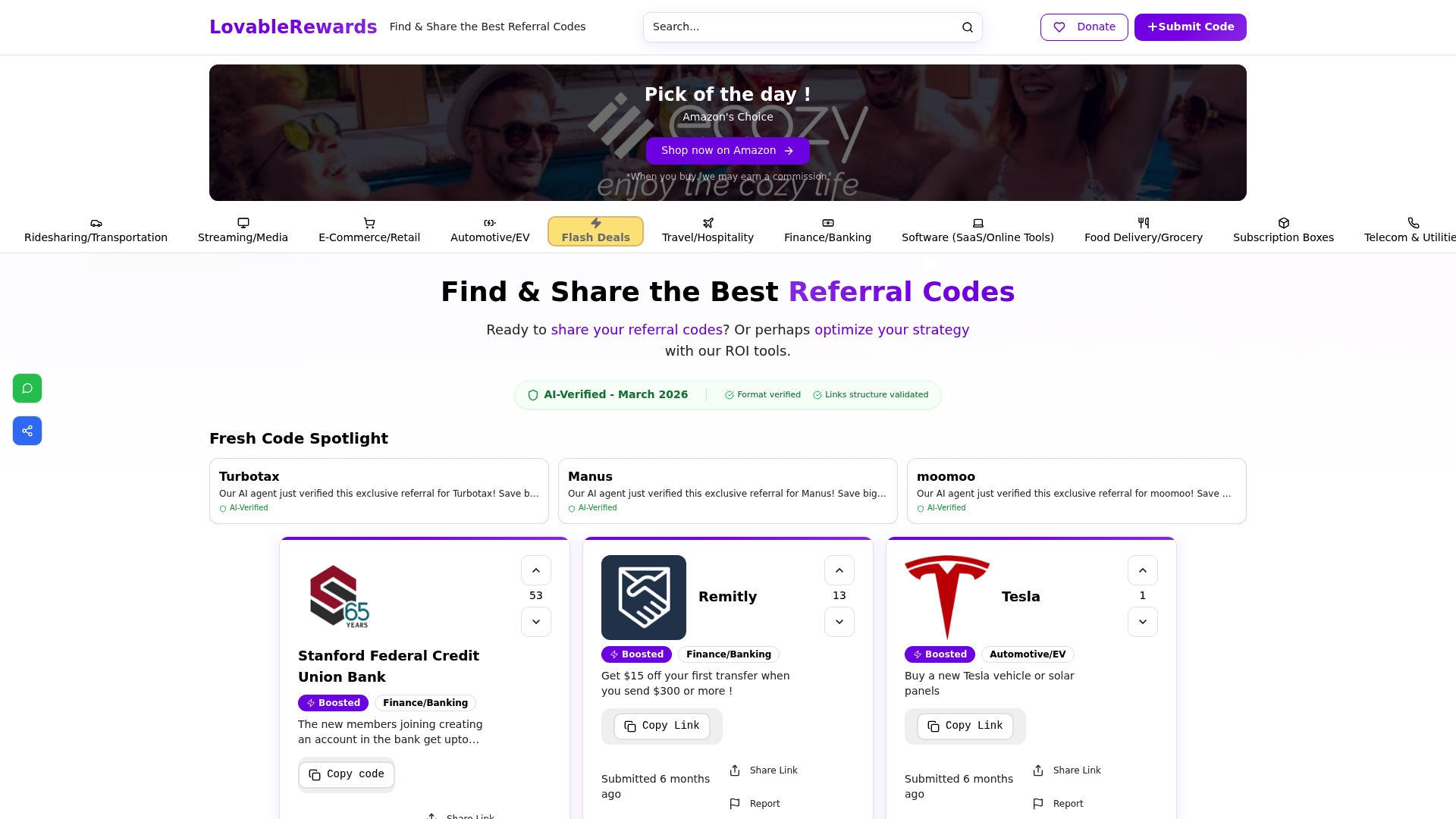
LovableRewards uses advanced AI verification paired with active community moderation to keep every code fresh, valid, and trustworthy. You can browse free tools for savings to find verified deals across e-commerce, finance, and transportation. Before submitting or sharing codes, the community guidelines ensure fair play and code integrity for everyone. Ready to start saving smarter? Explore working referral codes and join a community where AI and real users work together to keep deals honest.
Frequently asked questions
How does AI know if a discount code is valid?
AI tests codes in real time against merchant checkout systems and analyzes historical redemption data to predict validity with high accuracy.
Can AI prevent coupon code fraud?
Yes. AI detects suspicious patterns and rule-based systems flag abuse such as bot activity, over-redemption, and stacking violations in real time.
What are the main limitations of AI code verification?
AI can struggle with real-time data staleness and retailer-specific exclusions that change without notice, making community feedback essential for full coverage.
How do platforms keep codes up-to-date?
Platforms combine AI-driven retesting with community reporting so that codes are continuously checked and flagged the moment they stop working.