
You paste a promo code at checkout, hit apply, and nothing happens. No discount. No explanation. Just a red error message and a cart full of items at full price. That experience is more common than you think, and it costs shoppers real money. Failed promo codes can cause a 25% drop in conversions and lost savings for shoppers. Code verification is the system designed to stop that from happening, and understanding how it works puts you in a much stronger position to save consistently.
Table of Contents
- Why code verification matters for online shoppers
- What code verification means: The basics
- How the code verification process works behind the scenes
- Code verification from both sides: Shopper vs. merchant
- How to maximize your savings with verified codes
- Unlock more savings with truly verified referral codes
- Frequently asked questions
Key Takeaways
| Point | Details |
|---|---|
| Code verification protects savings | Verified codes help prevent frustration and wasted effort at checkout. |
| Use trusted sources and tools | Rely on platforms or extensions that show real-time results and user-confirmed codes. |
| Understand eligibility rules | A code’s success depends on factors like cart value, account status, and ongoing promotions. |
| Both shoppers and merchants benefit | Verification ensures shoppers find real deals and merchants maintain fair, fraud-free offers. |
Why code verification matters for online shoppers
The promise of a discount code is simple: enter it, save money. But the reality is messier. Most codes circulating on deal aggregator sites and coupon forums are scraped automatically, with no human checking whether they still work. Digital coupons have a 10% redemption rate compared to 1% for paper coupons, but 90% of scraped codes online fail. That gap between expectation and reality is where shopper frustration lives.
The financial stakes go beyond annoyance. Failed codes drop conversions by 25%, and coupon fraud costs US retailers billions annually. When fraud runs unchecked, merchants tighten restrictions, which means legitimate shoppers end up with fewer working deals. It becomes a cycle where everyone loses.
Verified codes break that cycle. When a platform actively checks whether a code is live, tests it against real carts, and timestamps the result, shoppers can trust what they find. Working referral codes that have been recently confirmed save you the trial-and-error frustration and help you complete purchases with confidence.
"The best coupon strategy isn't finding the most codes. It's finding the ones that actually work."
Verification also reduces cart abandonment. When shoppers know a code is valid before they commit to a purchase, they're far more likely to follow through. That's good for everyone involved.
- Expired codes waste your time and erode trust in deal platforms
- Fraudulent codes can sometimes expose users to phishing or fake checkout pages
- Unverified codes create uncertainty that pushes shoppers away from completing purchases
- Verified codes, confirmed by real users or automated systems, deliver consistent results
For a deeper look at how to get coupons that actually work, NerdWallet outlines strategies that align closely with what verified platforms already do.
What code verification means: The basics
A lot of shoppers use the words verification, validation, and redemption interchangeably. They're not the same thing, and knowing the difference helps you troubleshoot when something goes wrong.
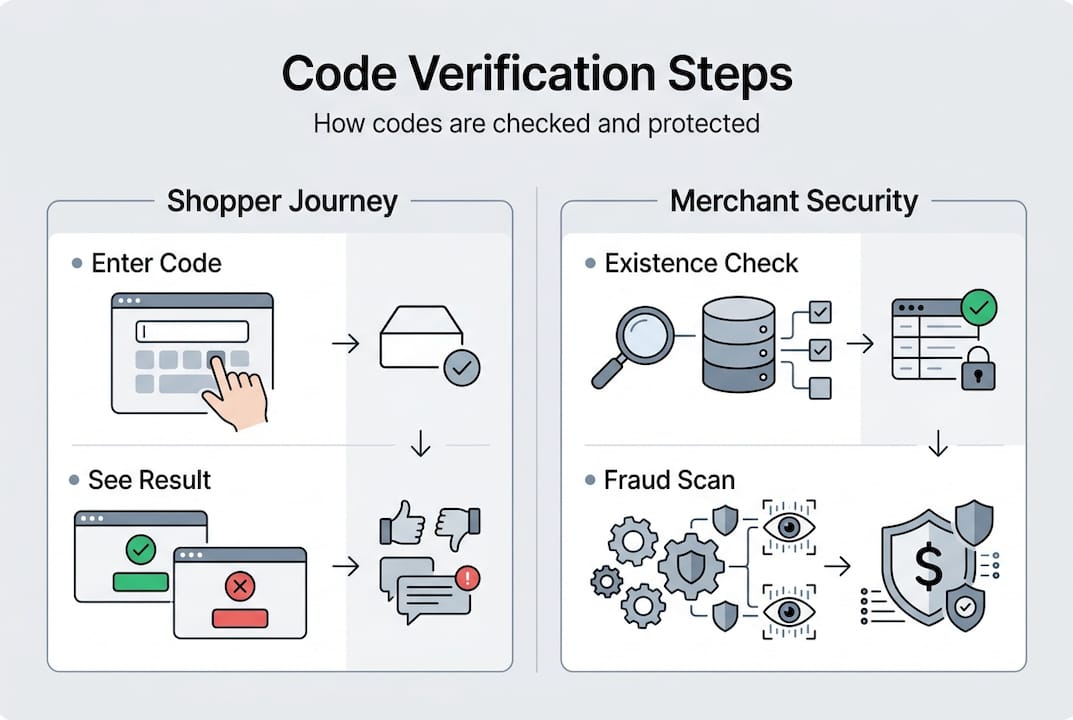
Code verification checks if a code exists and is associated with the system, before validation (rules and eligibility) and redemption (application and record). Think of it as three separate gates you pass through in sequence.
| Stage | What it checks | Who controls it |
|---|---|---|
| Verification | Does the code exist and is it active? | Merchant system |
| Validation | Does it apply to your cart, account, and channel? | Merchant rules engine |
| Redemption | Is the discount applied and the use recorded? | Checkout system |
Merchants keep these stages separate for a reason. Running all three checks at once would slow down checkout and create confusing error messages. By separating them, the system can tell you exactly where a code failed, whether it doesn't exist, doesn't apply to your situation, or has already been used.
Here's how the process typically flows from a shopper's perspective:
- You enter a code at checkout
- The system checks whether the code exists in its database (verification)
- The system checks whether the code applies to your specific cart and account (validation)
- If both checks pass, the discount is applied and the use is logged (redemption)
- You see the updated total and complete your purchase
Pro Tip: If a code fails at step two, it's either expired or doesn't exist. If it fails at step three, the issue is eligibility, like a minimum spend requirement or a new-customer-only restriction. Knowing which step failed helps you decide whether to troubleshoot or move on.
Platforms like verified community rewards on LovableRewards handle the first gate for you, so you're only dealing with validation questions, not dead codes. You can also review how code redemption works to understand the full flow before you shop.
How the code verification process works behind the scenes
When you hit "apply" on a promo code, a lot happens in under a second. The process starts on the client side, where your browser cleans up the input, stripping extra spaces or capitalization inconsistencies before sending the code to the server.
On the server side, mechanics include server-side existence checks, rule validation, fraud detection using IP and email matching, and measures like velocity monitoring. Velocity monitoring means the system tracks how many times a code has been tried from the same IP address or device in a short window. If the number spikes, it flags the activity as potential abuse.

| Method | What it detects | How it works |
|---|---|---|
| IP tracking | Repeated attempts from one location | Flags or blocks after threshold |
| Fuzzy email matching | Slight variations of the same email | Catches "name+1@email.com" tricks |
| Velocity monitoring | Rapid code-testing by bots | Rate-limits or blocks suspicious sessions |
| Self-referral detection | Users referring themselves | Cross-checks account and referral data |
Edge cases include self-referrals, bots probing for valid codes, and false positives in fraud detection. False positives are a real problem. A legitimate shopper using a VPN might get flagged as suspicious, even though they're doing nothing wrong. Good verification systems build in appeal or retry mechanisms for exactly this reason.
AI is making this process faster and more accurate. Machine learning models can now recognize patterns of abuse that rule-based systems miss, while also reducing false positives that block real customers.
- Cleanup: browser strips whitespace and normalizes capitalization
- Verification: server checks the code exists and is currently active
- Validation: rules engine checks cart value, customer type, and channel
- Fraud check: IP, email, and velocity data are reviewed simultaneously
- Redemption: discount is applied and the code use is recorded
Pro Tip: If you're testing a code and keep getting blocked, try clearing your cookies and using a different browser. Some fraud systems flag repeated failed attempts from the same session, even if you're a legitimate user.
Understanding preventing code misuse helps both shoppers and code contributors protect the integrity of deals they share.
Code verification from both sides: Shopper vs. merchant
Shopper and merchant priorities don't always line up, and that tension shapes how verification systems are built.
Shoppers want speed. They want to enter a code, see the discount applied instantly, and move on. Any friction, a slow response, a vague error message, or an unexplained rejection, creates doubt and often leads to cart abandonment. Clear, immediate feedback is the single most important thing a checkout system can offer.
Merchants, on the other hand, are managing risk. Merchant-side priorities include fraud detection and profitability, while shopper-side priorities center on savings and user experience. A merchant running a 30% off promotion needs to make sure that discount isn't being applied to orders that don't qualify, or used thousands of times by the same person.
"The best verification systems are invisible to honest shoppers and impenetrable to bad actors."
AI and automation are closing the gap between these two sets of needs. Modern systems can run fraud checks in milliseconds, meaning shoppers rarely notice the security layer at all. When it works well, verification feels like nothing. You enter a code, it works, and you save money.
When it doesn't work, the experience matters. A good system tells you why a code failed, not just that it did. "This code is for new customers only" is far more useful than "invalid code."
- Shoppers need: instant feedback, clear error messages, and confidence in code validity
- Merchants need: fraud prevention, budget controls, and accurate redemption tracking
- Both benefit from: AI-powered systems that are fast, accurate, and transparent
Using a loyalty points calculator alongside verified codes can help you stack savings strategically across multiple purchases.
How to maximize your savings with verified codes
Knowing how verification works gives you a real edge as a shopper. Here's how to put that knowledge into practice.
- Use platforms that timestamp their codes. A code confirmed working three days ago is far more reliable than one posted six months back with no update.
- Check user-confirmed status. Community platforms where real shoppers report success give you a second layer of confidence beyond automated checks.
- Test in incognito mode with a minimal cart. Shoppers should test codes in incognito mode with a minimal cart to avoid eligibility edge cases tied to browsing history or cart complexity.
- Read the code terms before applying. Minimum spend, product exclusions, and new-customer restrictions are the most common reasons valid codes don't apply to your specific order.
- Use browser extensions that auto-verify. Extensions that display real-time verification status and last-tested timestamps remove the guesswork entirely.
Pro Tip: If a code fails and you're sure it should work, try removing items from your cart one at a time. Some codes exclude specific product categories, and a single ineligible item can block the entire discount.
When troubleshooting a failed code, work through this checklist:
- Is the code spelled correctly, with no extra spaces?
- Does your cart meet the minimum spend requirement?
- Is the code restricted to new customers or a specific product category?
- Has the code already been used on your account?
- Is the promotion still active, or did it expire recently?
The most reliable shortcut is starting with a platform that does the verification work for you. How LovableRewards works shows exactly how AI-based verification and community confirmation combine to give you codes you can actually use.
Unlock more savings with truly verified referral codes
Spending time chasing codes that don't work is one of the most frustrating parts of online shopping. You've now got a clear picture of why codes fail, how verification systems work, and what separates a trustworthy deal from a dead link.
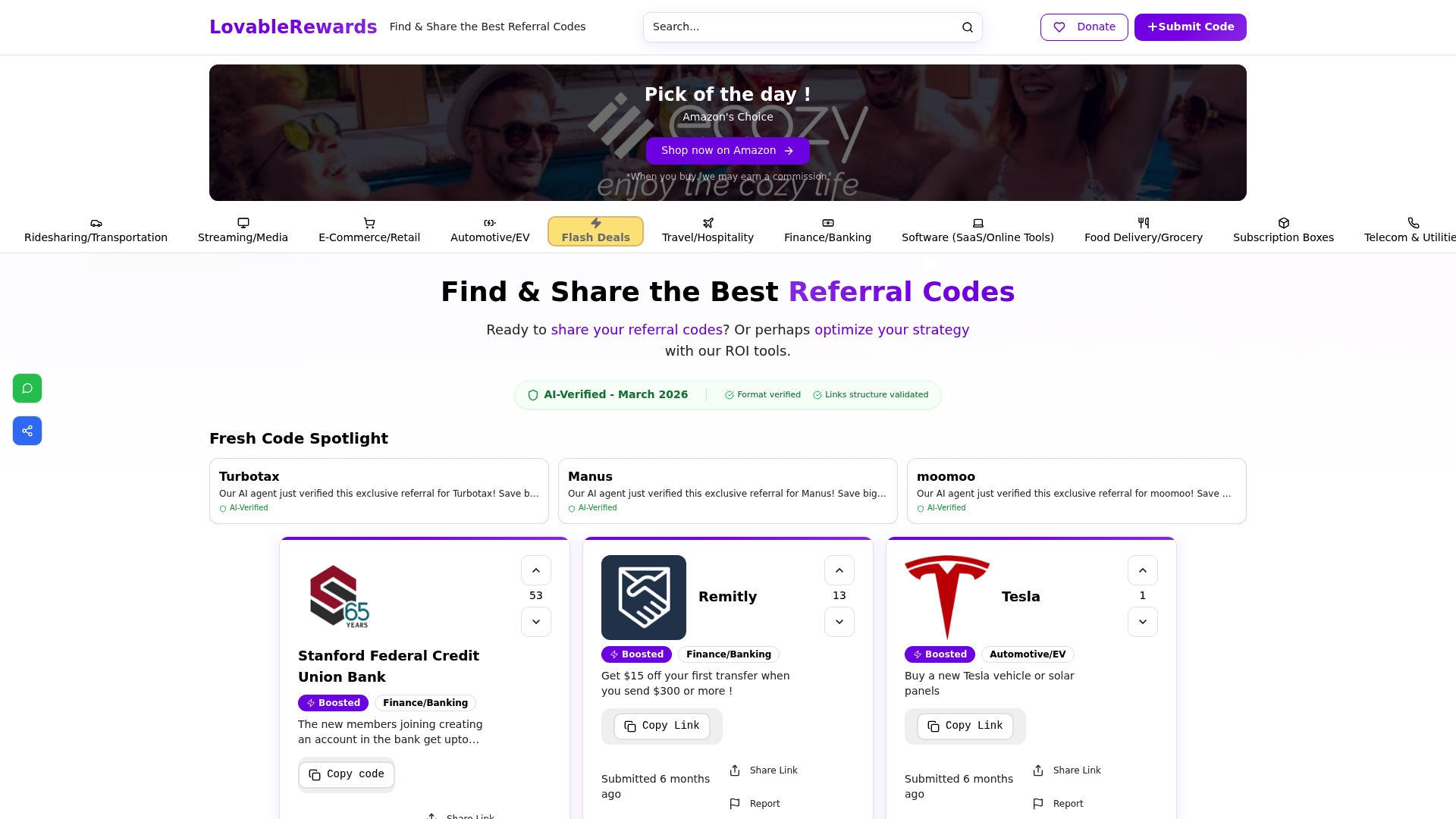
LovableRewards is built around the exact principles covered in this article. Every code on the platform goes through AI-based verification and community confirmation, so you're not guessing whether something works. You can find working referral codes across hundreds of categories, from e-commerce and financial services to transportation and subscriptions. If you want to understand the full process before you start, see how LovableRewards works and explore how fair rotation and verified listings make every deal worth clicking.
Frequently asked questions
How can I tell if a promo code is verified or not?
A code is verified if it carries a recent user-confirmed timestamp or is validated automatically by a browser extension with real-time verification. Platforms that show when a code was last tested give you the clearest signal of reliability.
Why do some codes work for other users but not me?
Codes often carry rules around customer type, minimum spend, or channel, so eligibility varies by account, cart contents, and timing. A code that works for a new customer won't apply to an existing account, even if the code itself is active.
How do merchants prevent code fraud?
Merchants use IP and email tracking, velocity limits, and AI models to catch self-referrals and automated code abuse. These systems run in the background and are invisible to legitimate shoppers.
What's the difference between verification, validation, and redemption?
Verification checks if a code exists and is active, validation checks eligibility against your specific cart and account rules, and redemption records the code being used and applies the discount to your order.