
TL;DR:
- Verify the true total cost including fees and compare it to historical prices to identify genuine deals.
- Test discount codes for validity and expiration before entering personal information to avoid wasted effort.
- Stack rewards, cashback, and loyalty points systematically to maximize overall savings without overspending.
Spotting a genuine deal has never been harder. Retailers use inflated "original" prices, countdown timers, and personalized algorithm feeds to make ordinary prices look like limited-time wins. The result? Millions of shoppers click "buy" thinking they scored a bargain, only to find the same item cheaper elsewhere the next day. A systematic checklist cuts through all of that noise. Instead of reacting to flashy banners and pushed notifications, you work through a clear, repeatable process that verifies every layer of a potential deal before you spend a single dollar. This guide walks you through exactly that process, step by step.
Table of Contents
- Step 1: Verify the true cost of the deal
- Step 2: Check for code validity and expiration
- Step 3: Stack rewards, loyalty, and cashback options
- Step 4: Score deals with community input and deal-sharing
- Why a checklist mindset outsmarts algorithmic 'deals'
- Unlock more verified deals and rewards
- Frequently asked questions
Key Takeaways
| Point | Details |
|---|---|
| Calculate total costs | Always figure the full price with shipping, taxes, and fees before deciding a deal is worth it. |
| Double-check code validity | Test and confirm codes have not expired before you commit at checkout. |
| Stack and combine offers | Combine discounts, loyalty, and cashback to maximize savings with smart planning. |
| Leverage deal-sharing groups | Tap into community insights to spot genuine deals and avoid misleading offers. |
| Stick to your checklist | Following a structured process protects your wallet from fake or inflated discounts. |
Step 1: Verify the true cost of the deal
With the stakes established, your first step is breaking down the true cost behind any potential deal. This sounds obvious, but most shoppers skip it entirely. They see "30% off" and stop thinking. The number that actually matters is what lands in your cart at final checkout, not the starting number on a product page.
To get that number, you need to add up every cost attached to the purchase. Shipping fees, handling charges, state and local taxes, subscription requirements, restocking fees for potential returns, and any mandatory bundled accessories all count. A $49 item with $12 shipping and $5 tax costs $66. That same item at a competing retailer for $55 with free shipping and no tax is actually cheaper, even though the listed price is higher.
"Calculate final landed cost including shipping, taxes, and fees, then compare to competitors and historical prices to avoid fake deals."
Once you have the true cost, benchmark it. Price history tools like CamelCamelCamel for Amazon or browser extensions such as Honey and Capital One Shopping show you what a product actually sold for over the past six to twelve months. Many "sale" prices are simply the product's regular price. If the current price is not meaningfully below the average historical price, the deal is not as strong as it appears.
Your Step 1 checklist:
- Write down the listed sale price
- Add all shipping and handling fees
- Add applicable taxes for your location
- Add any membership or subscription costs required to unlock the deal
- Look up the price history using a browser extension or price tracker
- Check the identical product (same model, same specs) at two to three competing retailers
- Compare your true landed cost against every option
Pro Tip: Build a simple spreadsheet with columns for retailer name, listed price, shipping, tax, total, and price history low. Filling it in for even two retailers takes under five minutes and regularly saves $15 to $40 per transaction.

Understanding how to read these numbers is a skill. Our discount code validation guide gives you even more detail on spotting inflated pre-sale prices before they fool you.
Step 2: Check for code validity and expiration
Once deal cost is verified, you'll want to make sure the discount code or offer is actually usable right now. This step sounds simple, but expired, region-locked, or single-use codes are far more common than most people realize. Nothing is more frustrating than filling out your billing information only to discover the code you copied from a deal forum stopped working three weeks ago.
The core rule here is to test the code before you invest time in the checkout process. Add your items to the cart, apply the code, and confirm the discount reflects correctly. Do this before entering your email, shipping address, or payment details. That way, if the code fails, you haven't handed over any personal information to a retailer you may not want to revisit.
Your Step 2 checklist:
- Locate the code's original source and check for a listed expiration date
- Search the retailer's official website or app for the same promotion to confirm it is still live
- Add items to cart and apply the code immediately, before any other steps
- Verify the discount amount matches what was advertised
- Check for minimum purchase thresholds or category exclusions
- Confirm whether the code is single-use or shareable
- If the code fails, look for a newer version on a verified aggregator before abandoning the deal
Code expiration is one of the top reasons shoppers leave money on the table. The avoiding expired code steps guide on our blog breaks down exactly how to set up alerts so you never chase a dead code again.
Loyalty programs add another layer of protection here. Nearly half of shoppers find deals through grocer and retail apps, which often include automatic code validation and expiration alerts built right into the experience. Signing up for a retailer's loyalty tier, even the free base level, frequently unlocks early access to sales, member-only codes, and push notifications that tell you when a deal is ending. Pairing app-based validation with a how to validate codes checklist doubles your accuracy rate.
Pro Tip: Sign up for two or three preferred coupon apps and link them to the retailers you shop most often. These apps often auto-apply the best available code at checkout, so you never forget to use a valid discount.
Step 3: Stack rewards, loyalty, and cashback options
After confirming code validity, you're ready to boost your savings by stacking multiple discount types. Stacking means layering different types of savings on a single transaction so the final price is far lower than any single discount alone would achieve. Done correctly, stacking is legal, encouraged by most retailers, and surprisingly straightforward.
Here is how the layers typically work. You start with a sale price or discount code. On top of that, you activate a cashback portal, such as Rakuten or TopCashback, before clicking through to the retailer. That portal gives you a percentage of your total back after purchase. Then you pay with a credit card that offers category-specific rewards, such as 3% back on online shopping. Finally, if the retailer has a loyalty program, your purchase adds points toward a future reward.
- Start with the lowest base price (use Step 1 to confirm this)
- Apply any verified discount codes (use Step 2)
- Activate a cashback portal before visiting the retailer's site
- Pay with a rewards credit card matched to the purchase category
- Confirm loyalty points are credited to your account within 48 hours of purchase
- Apply referral bonuses when opening a new account with a service or retailer
- Share verified codes with friends or family using a referral link to unlock additional bonuses for both parties
Stacking and loyalty strategies consistently yield 20 to 40 percent savings, particularly on open-box or clearance items. The key discipline is staying within your original budget even when stacking creates tempting math. Buying a $200 item you didn't need is not a savings win, even if you stacked 35% off.
Typical stacking scenarios by retailer type:
| Retailer type | Base discount | Cashback portal | Credit card rewards | Loyalty points | Estimated total savings |
|---|---|---|---|---|---|
| Electronics | 15% off sale | 5% cashback | 3% rewards | 2x points | 20 to 25% |
| Clothing | 25% off code | 8% cashback | 2% rewards | Bonus tier | 30 to 35% |
| Grocery delivery | $10 off first order | 3% cashback | 6% food rewards | Membership credits | 20 to 40% |
| Travel booking | 10% member rate | 4% cashback | 5x travel points | Status tier | 15 to 30% |
Use our loyalty points calculator to run these numbers for your specific accounts before committing to a purchase. You can also explore multi-industry referral code tips to find stacking opportunities across categories you may not have thought to combine.
Pro Tip: Refer a friend or family member to a retailer or service you are already planning to use. Many programs give both parties a bonus credit, so you save twice on a single transaction you were going to make anyway.
Step 4: Score deals with community input and deal-sharing
Sometimes, the biggest savings are hidden in plain sight within active deal-hunting communities. Algorithm-driven recommendations show you deals based on your browsing history. Community-sourced deals surface offers that real humans have tested, verified, and voted on, regardless of your personal data profile.
The difference is significant. A retailer's algorithm might show you a 20% discount on a laptop you browsed last week. A deal community might surface a stack combining a 15% sale, a $50 gift card bonus, and a cashback portal offer that brings the total savings to 38%, all on the same laptop, but only visible if you know where to look.
- Follow verified deal forums and community boards where users post real-time discount codes with usage reports
- Look for upvotes and verified user comments confirming a code worked recently
- Filter by "hot" or "verified" tags to skip expired or unconfirmed posts
- Share your own finds to build credibility and get early access to exclusive group deals
- Use community-reported price histories to cross-check retailer claims about original prices
The community is your best defense against retailers who inflate prices before a sale event. When dozens of users confirm a code worked within the last 24 hours, you can trust it far more than any banner ad.
Community-reported price data on landed costs consistently beats retailer-provided benchmarks because real users factor in all the hidden costs that official pages ignore.
Community deal tools comparison:
| Tool | Best for | Verification method | Typical deal quality |
|---|---|---|---|
| Slickdeals | Electronics, home goods | Community upvotes and comments | Very high |
| Reddit deal subs | Niche categories | User posts with proof | High, variable |
| LovableRewards | Referral and promo codes | AI verification plus community | High, multi-industry |
| Honey | Cart-stage automation | Automated code testing | Medium to high |
| Rakuten | Cashback stacking | Verified partner rates | High |
Dig deeper into how shared knowledge accelerates savings with our community deal sharing guide and explore community-driven deal insights to see real examples of group-sourced offers that individual shoppers routinely miss.
Why a checklist mindset outsmarts algorithmic 'deals'
Most savings advice focuses on where to find deals. We think the bigger issue is how you evaluate them. Platforms that push deals algorithmically are not optimizing for your savings. They are optimizing for your engagement, your click-through rate, and ultimately, your purchase. A "personalized deal" is often just a product the retailer has healthy margins on, dressed up with urgency language like "only 3 left" or "ends tonight."
The checklist mindset flips that dynamic entirely. Instead of reacting to what the platform wants you to see, you run every potential deal through a fixed, manual process. That process does not care about countdown timers. It does not respond to limited-stock warnings. It just asks the same four questions every time: Is this the real price? Does the code work? Can I stack more savings? What does the community say?
Retailers know that most shoppers skip at least one of those steps. The final landed cost check is the most skipped step of all, which is exactly why inflated shipping and fee structures persist. When you run the full checklist, you become genuinely difficult to fool.
There is also a budget discipline angle that most deal content ignores. Stacking is powerful, but it can paradoxically lead to overspending if you are not careful. Saving 40% on something you were not planning to buy is not a win. A checklist forces you to define your intended purchase and budget before you start looking. The deal either fits those parameters or it doesn't. That framing keeps impulse spending out of what should be a rational, deliberate process.
Our observation from watching thousands of community-sourced deals through community-driven deal perspectives is that the most successful deal hunters are not the most aggressive. They are the most systematic. They shop less often but save more per transaction, because they refuse to skip steps.
Unlock more verified deals and rewards
Ready to put this checklist to work with deals that are already verified before you even start? LovableRewards takes the manual validation work out of the equation by combining AI-based code verification with active community reporting across dozens of industries.
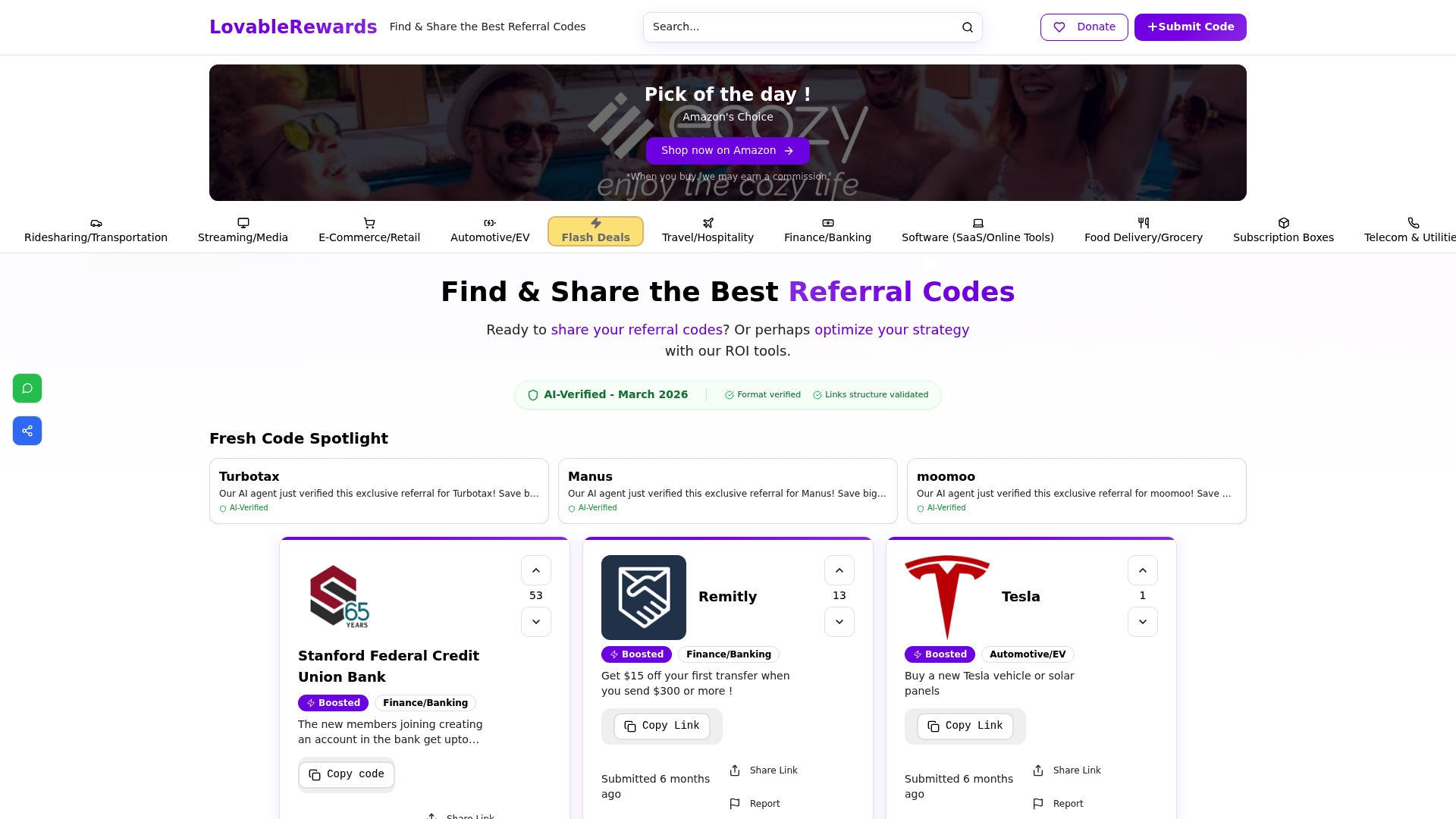
Every code on LovableRewards is screened for validity, expiration status, and link legitimacy before it appears in the catalog. You get access to categorized, community-validated offers spanning e-commerce, financial services, transportation, and more. The platform's fair rotation system means fresh codes surface regularly, and you can submit your own referral codes to give them maximum exposure. Whether you are stacking cashback on electronics or finding a referral bonus for a new banking account, LovableRewards is the verified starting point your checklist deserves.
Frequently asked questions
What is the most common mistake when hunting for discounts?
Many shoppers forget to compare the full landed price including all fees, sometimes paying more despite a "deal" banner. Always calculate total cost at checkout, not just the advertised sale price.
Do loyalty programs and apps really save money?
Yes. Nearly half of shoppers find deals through app-based and loyalty rewards programs that consistently deliver verified extra savings beyond standard discounts.
How can I make sure a deal isn't fake or inflated?
Cross-reference the item's price history using a tracking tool, check community-reported prices, and calculate all potential extra costs before finalizing your purchase to confirm the deal is real.
What's the advantage of deal-sharing communities?
Deal communities surface exclusive offers and provide real user verification, so you see confirmed savings that algorithm-driven recommendations would never show you based on your browsing history alone.