
TL;DR:
- Deal sharing involves sharing verified discount codes, cashback offers, and referral links to maximize savings.
- Verified community-backed deals and AI moderation ensure higher trust and better savings compared to unverified codes.
- Strategically stacking deals, referrals, and cashback can yield between 10 to 30 percent in savings.
Most people assume the best discounts are reserved for insiders, loyalty program veterans, or shoppers who spend hours hunting for codes. That assumption costs regular consumers real money every day. Deal sharing flips that script entirely. It's a practice built on the idea that savings grow when people share them, and it's already helping millions of everyday shoppers access verified cashback offers, referral bonuses, and exclusive discounts they'd never find on their own. This guide breaks down exactly what deal sharing is, how the mechanics work, and the smartest ways to stack rewards so you keep more cash in your pocket.
Table of Contents
- What is deal sharing? The basics explained
- How deal sharing works: Cashback, referrals, and rewards
- Deal sharing vs. other ways to save: What's different?
- Maximizing your savings with smart deal sharing
- A fresh perspective: Why deal sharing is reshaping online savings
- Discover even more savings with LovableRewards
- Frequently asked questions
Key Takeaways
| Point | Details |
|---|---|
| Deal sharing explained | Deal sharing lets you access and share verified discounts and earn rewards through referrals and cashback platforms. |
| Earn while you shop | You and your friends can earn extra bonuses by sharing and using referral links during your normal shopping. |
| Maximize your savings | By combining deal sharing with smart cashback strategies, users can achieve 10-30% real savings. |
| Community works best | Joining a trusted deal sharing community increases access to reliable offers and boosts personalized rewards. |
What is deal sharing? The basics explained
Deal sharing refers to the practice where consumers share verified discount codes, cashback offers, coupons, or promotional deals with others. It sounds simple, but the impact is significant. When one person finds a working promo code or a cashback link, sharing it with a community multiplies the benefit for everyone involved, not just the original finder.
At its core, deal sharing has three main elements:
- Discount codes: Alphanumeric strings entered at checkout to reduce your total price.
- Cashback offers: A percentage of your purchase price returned to you after a transaction is confirmed.
- Referral links: Unique URLs that track when a new user signs up or makes a purchase through your recommendation, rewarding both parties.
Who participates in deal sharing? Pretty much everyone. Regular shoppers share codes in Facebook groups and Reddit threads. Dedicated communities build entire platforms around it. And deal sharing platforms like the ones covered in our community deal sharing guide take it further by verifying codes before they go live.
Deal sharing has grown fast for a few reasons. Online shopping exploded, and with it came an overwhelming number of promo codes, many of which are expired or fake. Shoppers got burned. Trust became the missing ingredient. That's where verification changed everything.
"A shared deal is only as good as its source. Verified, community-backed offers carry far more weight than random codes floating around social media."
Platforms that verify codes using AI and community moderation solve the trust problem. Instead of wasting time on dead links, you get deals that actually work. This is also why community-driven deal benefits consistently outperform solo coupon hunting. The collective knowledge of a community catches expired offers faster than any single user could.
The CashKaro referral system is a strong real-world example of how deal sharing platforms formalize this process, turning casual code swapping into a structured, trackable rewards experience.
How deal sharing works: Cashback, referrals, and rewards
Now let's get into the actual mechanics. Understanding how money flows through deal sharing helps you use it more strategically.
Here's the basic step-by-step process:
- Sign up on a cashback or deal sharing platform.
- Browse active deals and select an offer from a retailer or service.
- Activate the deal by clicking through the platform's tracked link.
- Complete your purchase on the retailer's site within the session.
- Wait for confirmation as the platform verifies your transaction.
- Receive your cashback once the return period closes and the transaction is confirmed.
Users sign up on cashback sites, activate deals, shop through links, and get paid from affiliate commissions the platform earns. That commission gets split and returned to you as cashback. It's a win for the retailer (new sales), the platform (commission), and you (savings).

Tracking relies on cookies and unique referral links. When you click a deal link, a cookie is stored in your browser so the retailer knows the sale came through the platform. This is why opening a new tab or clearing cookies mid-session can break the tracking and cost you your cashback.
Referral rewards add another layer. When you invite a friend to join a platform, both of you benefit. You might earn a flat bonus or a percentage of their future cashback. Your friend gets a welcome bonus. These double-sided incentives are a core reason deal sharing feels more social than traditional savings methods. Learn more about how referral rewards work and the different referral program types that platforms use.
Here's a quick look at typical earnings across deal sharing methods:
| Method | Typical reward | Example |
|---|---|---|
| Cashback shopping | 2% to 15% per purchase | ₹20,000 total over time |
| Referral bonus (flat) | ₹500 to ₹1,000 per referral | 5 referrals = ₹5,000 |
| Referral bonus (% based) | 10% of friend's cashback | Ongoing passive income |
| Code sharing bonus | Visibility or credit boost | Platform-specific perks |
For more cashback shopping tips that help you avoid common tracking mistakes, it's worth bookmarking a reliable resource before your next big purchase.
Pro Tip: Always activate your cashback deal before adding items to your cart. Starting the session fresh from the platform's tracked link gives cookies the best chance to register your purchase correctly.
Deal sharing vs. other ways to save: What's different?
Deal sharing doesn't exist in a vacuum. You've probably used traditional coupons or earned credit card points before. So how does deal sharing actually compare?
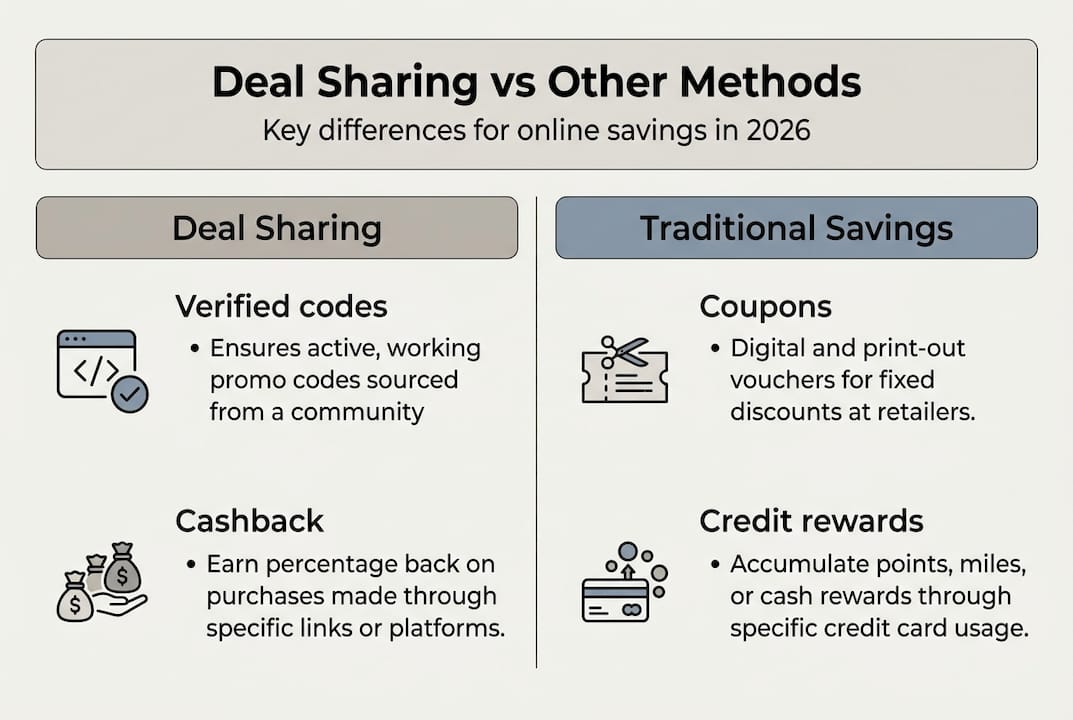
| Method | Ease of use | Savings potential | Reliability | Social element |
|---|---|---|---|---|
| Deal sharing | Medium | High (stackable) | High with verification | Strong |
| Traditional coupons | Easy | Low to medium | Variable | Minimal |
| Credit card rewards | Easy | Medium | High | None |
| Loyalty programs | Easy | Low to medium | High | Minimal |
Traditional coupons are convenient but limited. You clip, you apply, you save a fixed amount. There's no compounding effect, and expired coupons are a constant frustration. Credit card rewards are reliable and passive, but the savings rate rarely exceeds 2% to 3% on everyday purchases.
Deal sharing, especially when you stack methods, changes the math entirely. Imagine using a referral code for a signup bonus, activating cashback through a verified platform, and applying a promo code at checkout. That's three savings layers on a single transaction.
- Stack a referral bonus with cashback for double rewards.
- Combine a promo code with a cashback offer for immediate plus deferred savings.
- Use deal sharing platforms that verify codes so you're not wasting time on dead offers.
"Cashback portals are effective but require discipline; some prefer credit cards for simplicity."
That quote captures the honest tradeoff. Deal sharing rewards active participants. If you're willing to spend five extra minutes before a purchase, the returns are meaningfully higher than passive methods. For shoppers who want to set it and forget it, credit cards win on ease. But for deal hunters who enjoy the process, deal sharing consistently delivers more.
The social angle also matters. Double-sided referrals feel different from earning airline miles alone. When your friend also gets a reward, sharing feels generous rather than self-serving. That psychology drives more participation, which means more verified deals circulating in the community. Explore how AI-verified deal sharing is raising the bar for reliability across platforms.
Maximizing your savings with smart deal sharing
Knowing how deal sharing works is only half the equation. Using it well requires a bit of strategy and some discipline around the details.
Here are the most effective steps to maximize your results:
- Join verified platforms first. Community-moderated platforms with AI verification catch expired or fraudulent codes before you waste time on them.
- Read the terms before activating. Every cashback offer has conditions: minimum spend, eligible categories, return period rules. Skipping these is the number one reason cashback gets rejected.
- Stack deals deliberately. Use a referral code for signup, activate cashback before shopping, and apply a promo code at checkout. Follow the fair code sharing steps to do this without violating platform rules.
- Track your pending rewards. Most platforms show a dashboard of pending and confirmed cashback. Check it regularly so you can flag issues within the dispute window.
- Share your own codes. Contributing to the community increases your visibility and often earns you platform-specific perks. The community code workflow explains how to submit and manage codes effectively.
Stacking cashback and code sharing yields 10 to 30% savings on purchases when done correctly. That's a meaningful difference on a $200 electronics purchase or a $500 travel booking.
Common pitfalls to avoid:
- Activating a deal and then opening the retailer's site in a separate tab (breaks cookie tracking).
- Missing the return period window, which voids cashback on returned items.
- Sharing codes on platforms that penalize duplicate submissions.
Pro Tip: Use the referral ROI calculator to estimate your potential earnings before committing to a referral program. It takes the guesswork out of deciding which programs are worth your time.
A fresh perspective: Why deal sharing is reshaping online savings
Here's something worth saying plainly: traditional savings tools were designed for people who already knew how to use them. Loyalty programs reward frequent flyers, not occasional travelers. Credit card points favor high spenders. Even coupon systems historically required subscriptions or insider knowledge about stacking rules.
Deal sharing breaks that pattern. When a community verifies and circulates offers, the benefit flows to everyone, not just power users. Double-sided referrals are particularly interesting because they reframe savings as a shared experience. You're not just hunting for a deal alone. You're actively improving someone else's outcome at the same time.
This is what makes community-driven platforms genuinely different. The more people contribute verified codes, the better the experience gets for every new user. That feedback loop creates bigger real savings over time because the pool of working, verified offers keeps growing.
Transparency is the other underrated factor. Knowing when a code expires, how many people have used it, and whether it's been AI-verified removes the skepticism that stops people from trying new platforms. Trust, built through community and technology, is what turns casual deal sharing into a reliable savings habit.
Discover even more savings with LovableRewards
If this guide has you thinking about where to actually find verified deals, you're already asking the right question.
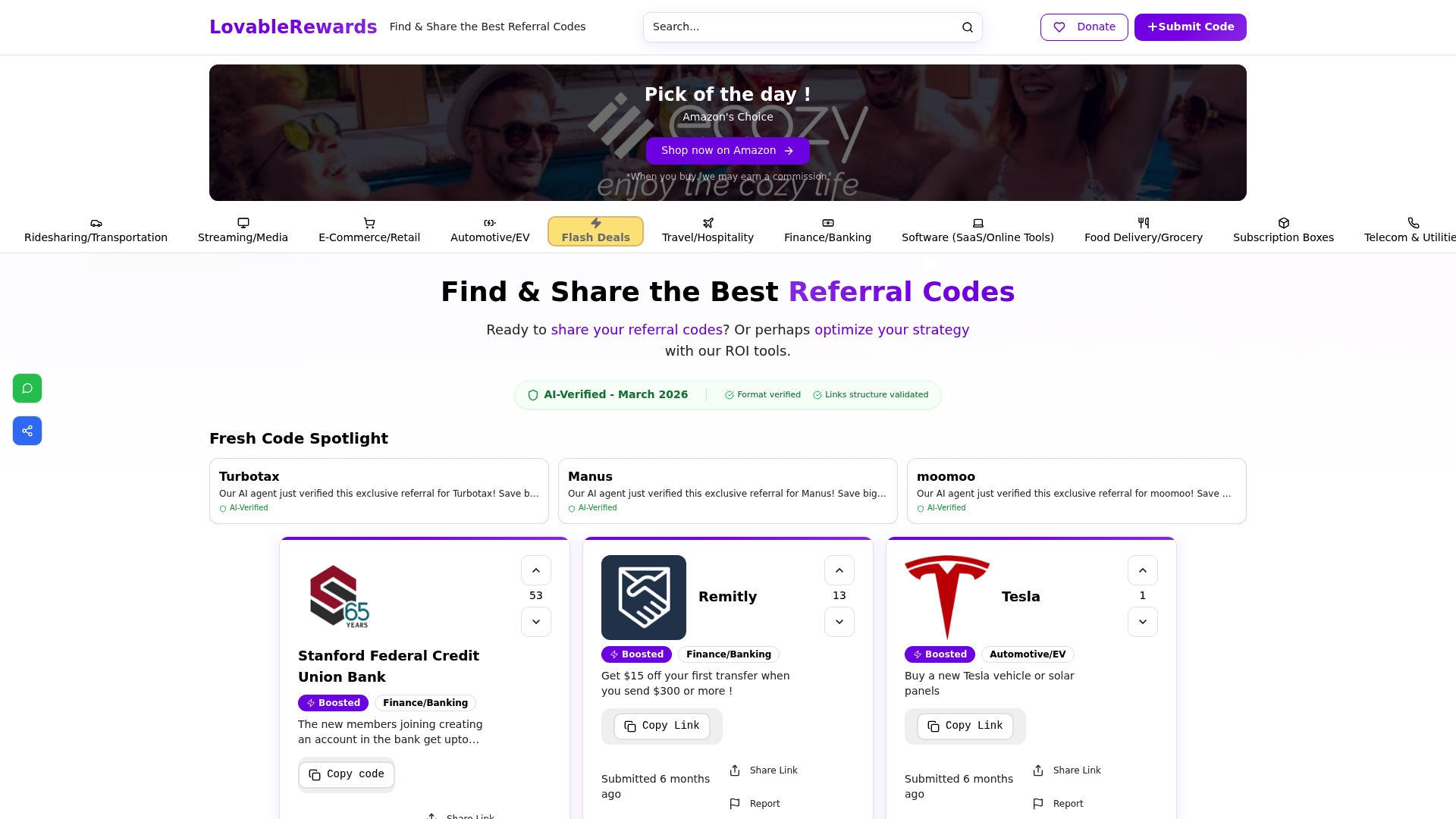
LovableRewards is a centralized hub where verified cashback offers, referral codes, and discounts are organized, checked, and ready to use. The platform uses AI-based verification and community moderation to ensure every code you find is active and legitimate. Whether you're new to deal sharing or looking to scale your referral earnings, LovableRewards gives you a trusted starting point. Browse by category, submit your own codes, and start stacking rewards with confidence. Thousands of deal hunters already use it daily to find savings across e-commerce, finance, and travel.
Frequently asked questions
What does deal sharing mean in online shopping?
Deal sharing refers to the practice where consumers share verified discount codes, cashback offers, coupons, or promotional deals with others, often earning rewards in the process.
How do referral rewards work in deal sharing?
When you refer a friend, you both earn extra cashback or bonuses. On platforms like CashKaro, the referrer gets 10% of the friend's cashback once the return period closes and the transaction is confirmed.
Is deal sharing better than using coupons or credit card rewards?
Deal sharing often allows you to stack rewards for higher savings, though it requires more active participation. Cashback portals are effective but require discipline, while credit cards win on simplicity.
How much can I save with deal sharing?
Typical users report 10 to 30% savings by stacking deals, cashback, and referral bonuses together on major platforms.