
TL;DR:
- Fake referral codes often feature unrealistically high discounts and lack legitimate promotional backing.
- Verifying the source and researching reports help identify and avoid fraudulent codes.
- Never share personal information before confirming a code’s authenticity from trusted platforms.
Fake referral codes are everywhere, and the worst part is that many of them look completely legitimate at first glance. Scammers have gotten remarkably good at mimicking real brand promotions, cloning trusted websites, and flooding social media with offers that promise incredible savings. The result? Millions of shoppers waste time entering codes that go nowhere, or worse, end up exposing their personal data to bad actors. The good news is that spotting fake codes is a learnable skill. With a clear set of criteria and a few smart habits, you can separate real savings from scams quickly and confidently.
Table of Contents
- Watch out for unrealistic deals: If it seems too good to be true, it probably is
- Check the code's source: Stick to official or verified platforms
- Google before you use: Research code reputation and reports
- Never give up personal information for a code
- Compare code features: Quick summary of common red flags
- Why trusting "gut instinct" can be risky with fake codes
- Find real savings through trusted communities and tools
- Frequently asked questions
Key Takeaways
| Point | Details |
|---|---|
| Spot unrealistic deals | If a discount seems too big, it’s likely a scam so stick to realistic offers. |
| Verify code sources | Use only official sites and trusted communities to minimize risk. |
| Investigate suspicious codes | Google questionable codes before using them to see if others reported scams. |
| Protect your personal details | Never share sensitive info for the promise of a discount code. |
| Use comparison strategies | Compare code features at a glance to quickly spot common warning signs. |
Watch out for unrealistic deals: If it seems too good to be true, it probably is
After understanding the challenge, let's start with the most common red flag: deals that are simply too good to be real.
Scammers know that big numbers grab attention. A code promising "90% off sitewide" or "free iPad with any purchase" is designed to short-circuit your skepticism. Your brain sees the number and immediately imagines the savings before it stops to ask whether the offer makes any business sense. That moment of excitement is exactly what fake code creators exploit.
According to the Better Business Bureau, unrealistic discounts like 90% off sitewide, no minimum spend, or free high-value items are textbook red flags shoppers should never ignore. Real brands simply cannot afford to operate at those margins, and when they do run steep sales, they advertise them openly through their own channels.
Here are the most common impossible deal structures you'll encounter:
- "90% off everything, no minimum spend": No retailer runs this across their full catalog.
- "Free high-value gift (iPhone, MacBook, gift card) with any purchase": Real promotions tie gifts to high-spending thresholds, not unlimited purchases.
- "$500 cashback on a $50 order": Cashback values never exceed what you actually spend.
- "Exclusive limited code for the first 5 users, expires in 10 minutes": Artificial urgency is a manipulation tactic, not a policy.
- Sites that mimic real brands: Fake sites copy logos and layouts. Always double-check the URL for subtle misspellings or added characters.
Reputable brands rarely offer extreme discounts through third-party code-sharing channels. Their real promotions are usually modest, like 10 to 20 percent off, free shipping, or a small referral bonus. For a look at what legitimate promotions actually look like, browse real offers for March 2026 to get a sense of realistic discount ranges.
Pro Tip: If a deal sounds like it would bankrupt the company offering it, it's not a real deal. Bookmark reliable code communities and cross-reference any code you find on social media before you use it.
Check the code's source: Stick to official or verified platforms
Recognizing fake-looking deals is just the start. Where a code comes from is equally vital.

The source of a referral code is often a more reliable indicator of its legitimacy than the discount itself. A 15% off code from an official brand newsletter is almost certainly real. The same code posted in a Facebook comment by an account with three friends and no profile picture? That's a completely different story.
Here's a quick breakdown of source reliability, from most trusted to least:
- Official brand websites and apps: The gold standard. If the brand is promoting it directly, it's real.
- Verified loyalty programs: Programs like cashback apps or rewards platforms have a reputation to protect and verify codes before listing them.
- Community-driven platforms with AI verification: Platforms that timestamp codes and use automated tools to validate links before publishing.
- Established deal forums with active moderation: Communities where users flag expired or fake codes quickly.
- Unverified social media posts and email forwards: Risky territory. Anyone can create a screenshot or forward an old email.
"The BBB and FTC both advise consumers to scrutinize the source of any coupon or code and treat 'too good to be true' offers as automatic warning signs, regardless of how professional they look." BBB Scam Alert
A verified platform will usually show you when a code was added, when it was last tested, and whether other users have successfully applied it. If none of that information is available, proceed with real caution. Learning more about finding verified referral codes can help you build a shortlist of trustworthy sources, and pairing that with habits around avoiding expired codes will save you a significant amount of frustration over time.
One underrated trust signal is a visible expiration date. Legitimate platforms show code validity windows. If a site lists no expiration and no verification date, that silence speaks volumes.
Google before you use: Research code reputation and reports
Once you know the source, it's time to check the wider web for feedback or warnings.
Even when a code comes from a source that looks semi-reliable, a 60-second search can reveal whether other shoppers have flagged it as suspicious. Many fake codes circulate for months before platforms pull them down. But community members often spot and report them much faster.
As the Better Business Bureau recommends, searching Google for complaints about a specific code is one of the quickest and most effective checks available to any shopper. The search formula is simple: enter the code followed by the words "scam," "complaint," or "not working."
Here's a step-by-step process for researching a code before you use it:
- Copy the exact code you want to test. Don't paraphrase it.
- Open a search engine and type the code in quotation marks, followed by "scam" or "review."
- Scan the first page of results. If forum posts, Reddit threads, or consumer complaint boards appear, read them.
- Check specialized scam databases like BBB's Scam Tracker or the FTC's consumer reporting portal.
- Look at the date of complaints. A single complaint from two years ago is less alarming than five complaints from the past week.
- Search for the platform or site offering the code, not just the code itself. Patterns of fraud often trace back to specific bad actors.
Platforms that use AI-powered code verification automate much of this research for you, but manual searching still catches edge cases. If you want a structured approach for this, a step-by-step guide to validating discount codes can help you build this into a repeatable habit.
| Search result type | What it likely means | Action |
|---|---|---|
| No results at all | Code is either brand new or obscure | Proceed with extra caution |
| Multiple recent scam reports | Code is flagged by community | Avoid immediately |
| Success posts from verified users | Code is likely working | Safe to try |
| Mixed results, some old complaints | Code may be expired or intermittent | Test on low-stakes purchase |
| Official brand press release | Code is confirmed and current | High confidence, proceed |
This table gives you a fast decision framework. The middle column tells you the real story: what each result pattern actually signals about the code's reliability.
Never give up personal information for a code
Even if a code looks genuine online, be cautious before handing over personal data.
Here's something that catches even experienced shoppers off guard. Some fake code sites don't steal money directly. Instead, they collect personal information under the guise of "verifying your eligibility" for a discount. Once they have your data, the code either never works or arrives as a low-quality placeholder while your information gets sold to third parties.
The BBB specifically highlights that legitimate merchants never request personal info like your full name, home address, or payment details just to view or receive a referral code. If a site asks for any of the following before revealing a code, leave immediately:
- Full legal name and date of birth: No code site needs this.
- Home address or phone number: Referral codes are digital. No shipping address is required to receive one.
- Payment card details "just to verify your identity": This is a direct theft attempt.
- Social Security number or national ID: Completely unacceptable for any discount offer.
- Account login credentials for another service: Never share passwords on a code-sharing site.
Fake code sites that harvest personal data often look indistinguishable from legitimate coupon platforms. They use borrowed logos, fake testimonials, and realistic checkout-style forms. The tell is always in what they ask for, not how they look.
Learning more about code verification methods that protect your data can help you understand what proper platforms do instead. Reputable platforms verify codes themselves, so you never have to prove anything to access them.
Pro Tip: Create a disposable email address specifically for deal-hunting. Use it when any site asks for an email to unlock a code. This keeps your main inbox clean and limits exposure if the site turns out to be sketchy.
Compare code features: Quick summary of common red flags
For even faster decision-making, here's a one-glance comparison of the most common red flags.
Once you've worked through the criteria above, you can check a code against this reference table in under a minute. Think of it as your field guide to spotting fakes fast.
| Warning sign | Low risk | Medium risk | High risk |
|---|---|---|---|
| Discount level | 5 to 20% off | 30 to 50% off with conditions | Over 60% off, no conditions |
| Code source | Official brand site or verified platform | Established forum, no verification badge | Social media post, unknown account |
| Online reputation | Positive reviews, no complaints | Mixed or outdated reviews | Recent scam reports or no trace online |
| Personal info request | None required | Email only, trusted site | Name, address, payment details required |
| Expiration info | Clear date shown | No date, but code is recent | No date, code appears old or recycled |
| Site URL | Exact brand domain | Similar domain, slight variation | Misspelled domain, random characters |
This comparison does something simple but powerful: it forces you to look at multiple dimensions before trusting a code. Most fake codes trigger two or three "high risk" flags simultaneously, which makes them easier to reject once you know what to look for.
For those who want this process automated, platforms offering AI-verified referral codes run these checks in real time, so the heavy lifting is already done by the time you see a code listed.
Using community-driven tools alongside your own research habits creates a layered defense that fake codes struggle to get through. The best deal hunters don't rely on any single check. They use all of them together.
Why trusting "gut instinct" can be risky with fake codes
Here's an uncomfortable truth that most deal-hunting advice avoids: your instincts are not reliable protection against modern fake codes.
Scammers study human psychology. They know that a well-designed page, a familiar logo, and a sense of urgency can override rational skepticism in most people. The BBB has documented multiple consumer complaints from shoppers who felt confident about a code right up until the moment they realized their reward was never coming.
Gut instinct evolved for physical environments where deception is harder to sustain. Online, a bad actor can spend $20 on a professional-looking website that passes your visual inspection every time. The feeling of "this looks right" is not a data point. It's just a feeling.
What works instead is systematized skepticism. Verified community lists, AI-driven validation tools, and structured research habits create a process that your gut cannot replicate alone. When you use platforms built on transparent verification, you benefit from the collective experience of thousands of shoppers who already tested the code before you arrived.
For real examples of how that process plays out across different industries, the breakdown in maximizing savings with examples shows how verified codes perform compared to unverified ones. The gap is significant, and it only widens as scammers get more sophisticated. Trust the data. Use the tools. Leave instinct for choosing which restaurant to try on a Friday night.
Find real savings through trusted communities and tools
Ready to put these tips into action and save with confidence? Here's where to start.
At LovableRewards, we built the platform specifically because the fake code problem needed a real structural solution, not just another blog post. Every code listed goes through AI verification before it appears, and community members flag anything that slips through. You never have to wonder whether a code is real.
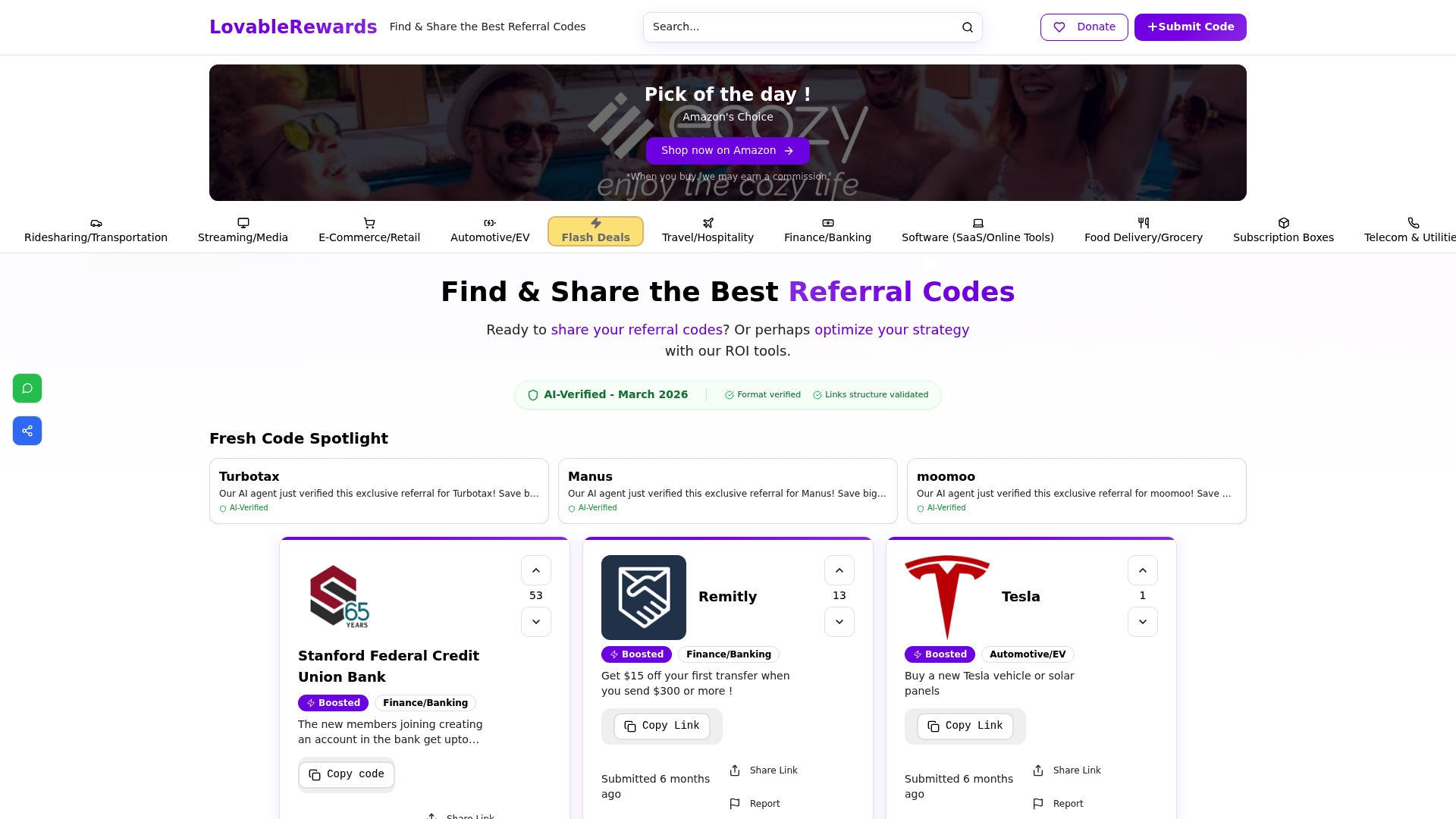
Start by reviewing our trusted community guidelines to understand how codes are submitted, verified, and moderated. Then explore our shopper tools to check codes quickly before you buy. And when you're ready to find something specific, browse the full library of verified working codes organized by category and recency. Real savings, verified by real people and real technology, are one search away.
Frequently asked questions
What are the biggest warning signs of a fake code?
Unrealistic discounts like 90% off sitewide, requests for personal information before revealing the code, and codes spread via unverified social media accounts are the three major red flags to watch for.
Can fake codes actually harm you or just waste your time?
Fake codes can cause genuine harm beyond frustration. The BBB has recorded consumer complaints about non-delivery and privacy breaches linked to fake coupon sites that collect personal data.
How can I check if a code is safe to use?
Searching Google for the code combined with "scam" or "complaint" is the fastest manual check, and using a verified platform like LovableRewards adds an extra layer of automated confidence.
Is it ever okay to give my email for a code?
Only share your email with official brand sites or well-established, trusted platforms that verify codes properly. Never provide any email to an unknown site offering a suspicious code with an unusually large discount.